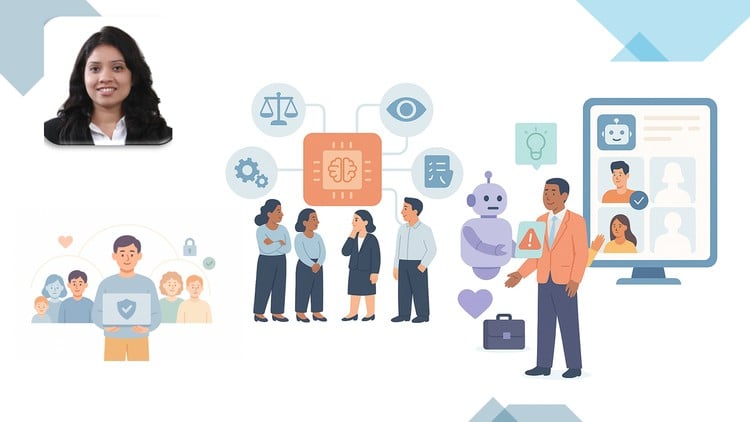
Practical guide to fairness, transparency, accountability, and privacy in ethical AI for workplace applications.
⏱️ Length: 58 total minutes
👥 151 students
🔄 October 2025 update
Add-On Information:
Note➛ Make sure your 𝐔𝐝𝐞𝐦𝐲 cart has only this course you're going to enroll it now, Remove all other courses from the 𝐔𝐝𝐞𝐦𝐲 cart before Enrolling!
- Course Caption: Practical guide to fairness, transparency, accountability, and privacy in ethical AI for workplace applications. Length: 58 total minutes 151 students October 2025 update
- Course Overview
- Navigate AI’s evolving ethical landscape, empowering leaders for principled decision-making beyond technicalities.
- Translate ethical concepts into tangible strategies for responsible AI integration across diverse business functions.
- Proactively address AI’s moral implications, safeguarding reputation and fostering long-term organizational trust.
- Grasp the strategic imperative of embedding ethics in AI governance, shifting from reactive to proactive ethical design.
- Empower leadership to champion human-centric AI, aligning technological progress with core organizational values.
- Discover ethical AI leadership as a key differentiator, attracting stakeholders and driving competitive advantage.
- Gain holistic perspective on responsible AI: societal impact, regulatory pressures, and operational shifts.
- Foster organizational culture where ethical considerations integrate into every AI development stage.
- Anticipate future ethical AI challenges and develop resilient mitigation strategies.
- Requirements / Prerequisites
- Foundational understanding of business operations and strategic decision-making.
- No deep AI development expertise required; focus on ethical governance and leadership.
- Curiosity about technology’s ethical dimensions and impact on modern enterprises.
- Commitment to fostering responsible innovation and upholding societal values in business.
- Openness to ethically evaluate technological advancements.
- Motivation to integrate ethical thinking into strategic planning and execution.
- Interest in balancing business objectives, AI capabilities, and ethical responsibilities.
- Desire to contribute to trustworthy, human-centric AI solutions.
- Skills Covered / Tools Used
- Strategic ethical decision-making frameworks for enterprise AI implementation.
- Techniques for effective stakeholder engagement in ethical AI system deployment.
- Methods for establishing internal AI ethics review and governance structures.
- Approaches to cultivating an organizational culture of AI responsibility and integrity.
- Frameworks for conducting ethical impact assessments on AI systems (harms and benefits).
- Strategies for communicating complex AI ethical issues to diverse non-technical audiences.
- Principles for integrating ethics throughout the entire AI development lifecycle.
- Best practices for designing human-in-the-loop AI oversight mechanisms.
- Tools for fostering ethical alignment between corporate policies and global AI standards.
- Conceptual models for analyzing AI ethical dilemmas (e.g., fairness, autonomy, beneficence).
- Benefits / Outcomes
- Elevate organizational reputation and public trust through consistent, responsible AI practices.
- Mitigate legal, regulatory, and reputational risks associated with AI deployment.
- Enhance talent attraction and retention by showcasing an ethically conscious, innovative environment.
- Improve customer loyalty and satisfaction by prioritizing ethical data handling and responsible tech use.
- Gain sustainable competitive advantage through proactive deployment of trustworthy, ethically sound AI systems.
- Develop robust, future-proof internal policies aligning with global AI ethics standards and best practices.
- Increase confidence navigating complex, dynamic global AI regulatory landscapes, ensuring proactive compliance.
- Drive impactful innovation without compromising human values, balancing progress with ethical integrity.
- Cultivate a resilient business model prepared to anticipate and effectively respond to future ethical AI challenges.
- Empower leaders to champion ethical responsibility, becoming catalysts for positive change in the AI ecosystem.
- PROS
- Provides highly relevant, practical insights for modern business AI challenges.
- Empowers leaders with crucial knowledge to navigate AI ethical complexities, fostering responsible innovation.
- Offers a concise, comprehensive overview, ideal for busy professionals grasping essential AI ethics.
- Aids proactive risk mitigation, safeguarding reputation and ensuring compliance in evolving AI landscape.
- Enhances decision-making by integrating ethical considerations into strategic planning.
- Cultivates a competitive advantage from building inherently trustworthy AI systems.
- CONS
- The course’s brevity may necessitate further deep-dive study for highly complex organizational transformations or technical implementations.
Learning Tracks: English,Business,Other Business
Found It Free? Share It Fast!