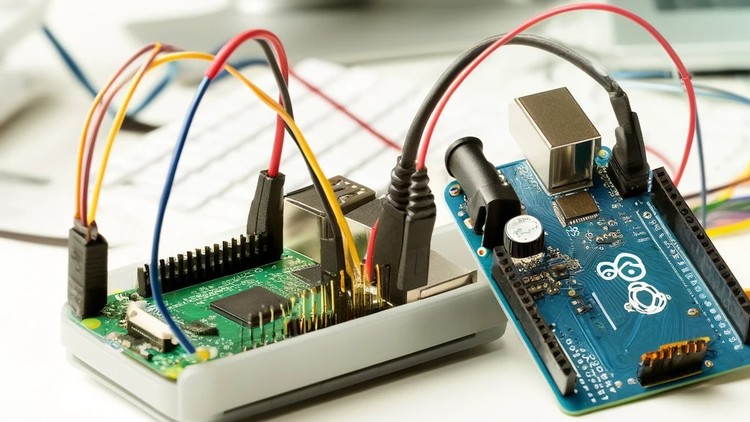
In this Course you will learn how to connect Raspberry Pi and Arduino the software and hardware part and why it’s useful
⏱️ Length: 1.2 total hours
⭐ 3.98/5 rating
👥 14,345 students
🔄 June 2025 update
Add-On Information:
“`html
Note➛ Make sure your 𝐔𝐝𝐞𝐦𝐲 cart has only this course you're going to enroll it now, Remove all other courses from the 𝐔𝐝𝐞𝐦𝐲 cart before Enrolling!
- Course Overview
- Unlock the powerful synergy of Raspberry Pi and Arduino. Learn their seamless integration to transform simple standalone projects into sophisticated, interconnected solutions.
- Discover the strategic advantage of combining Raspberry Pi’s robust OS, processing, and networking with Arduino’s real-time control and precise timing. Orchestrate their unique features for maximum impact.
- Gain insights into how a cohesive ecosystem delegates complex computations and internet communication to the Pi, while critical, time-sensitive tasks go to the Arduino for more efficient and powerful designs.
- Master essential techniques for stable communication and data exchange through a practical, hands-on journey, bridging high-level software development with low-level hardware control.
- Enhance your project portfolio in advanced home automation, robotics, environmental monitoring, and interactive installations by confidently designing hybrid embedded systems.
- Requirements / Prerequisites
- Basic Electronics Fundamentals: Understanding of electronic components and circuit concepts.
- Familiarity with Raspberry Pi: Experience with Raspberry Pi OS, basic command-line, and simple Python scripts.
- Familiarity with Arduino: Knowledge of Arduino IDE, basic C/C++ sketches, and fundamental programming.
- Required Hardware: Raspberry Pi (e.g., Pi 3B+/4), Arduino (e.g., Uno/Nano), breadboard, jumper wires, resistors, and an LED.
- Software Tools: Raspberry Pi OS, Arduino IDE, and a Python development environment.
- No Expert Programming Skills: Foundational coding knowledge is sufficient; course focuses on specific interfacing code.
- Skills Covered / Tools Used
- Serial Communication Protocols: Implement UART for reliable, bidirectional communication between Pi and Arduino, including baud rate and data format setup.
- Python Scripting for Pi-Arduino Interface: Craft Python programs on Raspberry Pi to send commands and receive structured data, utilizing libraries like
PySerial. - Arduino Sketch Development for Interfacing: Write Arduino sketches to parse incoming serial data, execute hardware operations (e.g., actuators), and format data for Pi transmission.
- Strategic Hardware Interconnection: Master wiring techniques, including proper GPIO pin selection, voltage level compatibility, and safe component usage.
- Data Packet Formulation and Parsing: Explore strategies for encoding/decoding data payloads, ensuring clarity and integrity for commands and sensor readings.
- Cross-Platform Debugging Methodologies: Cultivate systematic troubleshooting skills for wiring errors, protocol mismatches, and software logic bugs in both Python and Arduino environments.
- Fundamentals of Hybrid System Architecture: Gain a conceptual framework for designing modular systems where Pi handles high-level functions (network, UI) and Arduino manages real-time control.
- Tools Utilized: Practical engagement with Raspberry Pi OS command line, Arduino IDE, Python with
PySerial, and fundamental electronic components.
- Benefits / Outcomes
- Create Advanced Embedded Systems: Design and implement sophisticated IoT, robotics, and automation systems using combined SBC and microcontroller power.
- Optimize System Performance: Strategically allocate tasks, leveraging Pi for high-level processing and Arduino for low-latency, real-time control, enhancing efficiency.
- Master Integrated Prototyping: Gain expertise in combining different hardware platforms, accelerating your ability to prototype complex solutions.
- Enhance Problem-Solving Acumen: Develop a methodical approach to troubleshooting and resolving complex integration challenges across diverse technical ecosystems.
- Deepen Practical Protocol Knowledge: Move beyond theoretical understanding by practically implementing and debugging serial communication protocols in real-world scenarios.
- Boost Career Opportunities: Acquire highly valuable skills in embedded systems integration, becoming more competitive for roles in IoT, robotics, and automation.
- Design Modular and Scalable Projects: Structure projects effectively by segmenting responsibilities, leading to more maintainable and scalable designs.
- Unleash Creative Freedom: Break previous project limitations by combining the vast software ecosystem of Raspberry Pi with Arduino’s direct hardware control for unique inventions.
- PROS
- Highly Targeted and Efficient: Delivers core integration knowledge in a concise 1.2-hour format.
- Strong Community Validation: High 3.98/5 rating from over 14,000 students indicates practical value.
- Hands-On Learning Focus: Emphasizes practical application for immediately usable skills.
- Up-to-Date Content: June 2025 update ensures material is current with best practices.
- Accessible and Budget-Friendly: Uses widely available, affordable hardware for learning.
- CONS
- Limited Advanced Topic Depth: Due to short duration, may not cover highly complex scenarios or advanced optimization in detail.
“`
Learning Tracks: English,IT & Software,Hardware
Found It Free? Share It Fast!