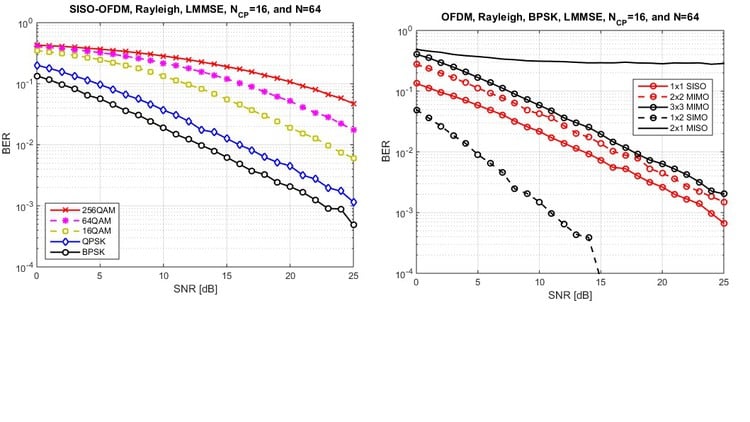
A step by step the Matlab codes for BER estimations of different Comm. systems like OFDM and NOMA Comm. systems
⏱️ Length: 3.5 total hours
⭐ 4.40/5 rating
👥 14,082 students
🔄 February 2021 update
Add-On Information:
Note➛ Make sure your 𝐔𝐝𝐞𝐦𝐲 cart has only this course you're going to enroll it now, Remove all other courses from the 𝐔𝐝𝐞𝐦𝐲 cart before Enrolling!
- Course Overview
- Dive into MATLAB as a quintessential tool for analyzing and designing modern wireless communication systems. This course offers a hands-on pathway to simulate complex scenarios, building end-to-end communication system models to understand performance implications and system-level design challenges.
- Uncover methodologies for robust performance evaluations of wireless links, focusing on crucial metrics for system reliability. Gain a framework for quantitatively assessing design choices and making informed decisions based on simulated outcomes.
- Understand the significance of channel modeling and its impact on system design in diverse wireless environments. Appreciate complexities introduced by fading and interference, learning to accurately represent these phenomena in simulations.
- Grasp MATLAB’s utility in bridging abstract wireless communication theory with tangible engineering applications. Through guided coding, witness how mathematical models translate into executable code, revealing underlying algorithms.
- Develop foundational understanding to adapt simulation frameworks for emerging wireless technologies. Principles learned are transferable to advanced concepts like massive MIMO, cognitive radio, and IoT communication.
- This course serves as a vital resource for students, researchers, and engineers to solidify their understanding of wireless system behavior through empirical observation, building confidence to tackle real-world design problems.
- Requirements / Prerequisites
- A foundational grasp of basic digital communication principles (modulation, demodulation, channel impairments, SNR) to appreciate practical implications in MATLAB simulations.
- Working knowledge of MATLAB programming fundamentals (variables, arrays, loops, conditionals, functions). Prior scripting experience significantly enhances learning pace.
- An elementary understanding of linear algebra concepts (matrices, vectors) crucial for comprehending multi-antenna (MIMO) system operations and mathematical representation.
- Familiarity with essential digital signal processing (DSP) concepts (filtering, Fourier transforms, sampling theory) underpinning many simulated communication system blocks.
- Access to an installed and operational version of MATLAB software (R2017a or newer) for active participation in coding exercises and practical examples.
- A keen interest in wireless communication engineering and readiness for practical, code-centric learning to bridge theory and simulation.
- Skills Covered / Tools Used
- Master algorithmic implementation in MATLAB, translating complex wireless communication theories into functional code. Learn to construct and integrate system components into a coherent simulation framework, developing strong programming practices.
- Acquire expertise in advanced channel modeling techniques, simulating realistic wireless propagation environments beyond basic AWGN. Develop code for generating complex fading characteristics and understanding their impact.
- Develop proficiency in performance analysis and data visualization, creating meaningful plots (e.g., constellation diagrams, BER curves) to interpret simulation results effectively for data-driven design decisions.
- Gain practical experience in designing and evaluating equalization schemes to mitigate channel impairments. Implement and compare different linear equalization algorithms, understanding their strengths and limitations in various scenarios.
- Learn to implement and simulate core functionalities of Orthogonal Frequency Division Multiplexing (OFDM) systems, from symbol mapping to IFFT/FFT and cyclic prefix insertion, providing a deep dive into this prevalent technology.
- Develop capabilities in simulating Multiple-Input Multiple-Output (MIMO) communication systems, understanding how spatial multiplexing and diversity are implemented in MATLAB for enhanced data rates and reliability.
- Utilize MATLAB to conduct comparative studies between different modulation schemes, channel conditions, and system architectures, enabling critical evaluation of trade-offs and informing optimal design choices.
- Enhance your debugging and troubleshooting skills within the MATLAB environment, essential for developing robust, error-free simulation code for complex communication systems.
- The primary tool is MATLAB, an industry-standard platform for scientific computing and engineering simulations. Gain hands-on experience with its scripting, plotting, and data analysis functionalities tailored for wireless communication.
- Benefits / Outcomes
- Emerge with a robust portfolio of practical MATLAB codes for wireless communication system simulations, directly applicable to academic projects, research, or industrial R&D roles.
- Attain a deeper, intuitive understanding of complex wireless communication theories by actively implementing and observing their behavior in a simulated environment, solidifying conceptual knowledge.
- Develop significant problem-solving and analytical skills specific to wireless engineering, enabling independent modeling, simulation, and analysis of communication systems.
- Gain confidence in utilizing MATLAB for engineering analysis, becoming proficient in its application for system design, performance evaluation, and troubleshooting in the wireless domain.
- Be better prepared for advanced studies or career opportunities in wireless communication, equipped with theoretical understanding and crucial hands-on simulation experience.
- Acquire the ability to critically evaluate and interpret performance metrics of wireless systems, understanding design trade-offs and optimizing parameters for desired outcomes.
- Bridge the gap between academic theory and real-world engineering challenges, developing a practical perspective on how wireless systems are designed, tested, and optimized.
- Possess foundational knowledge and skills to further explore cutting-edge topics in wireless communication like 5G/6G, IoT connectivity, by extending learned simulation principles.
- PROS
- Hands-On Learning: Provides direct experience with MATLAB coding for practical wireless communication system simulations.
- Industry-Relevant Skills: Equips learners with in-demand skills for R&D, academia, and telecom sectors.
- Concise and Focused: Offers a substantial amount of practical knowledge within a manageable 3.5-hour duration.
- Solid Foundation: Lays a strong groundwork for understanding and simulating advanced wireless technologies.
- Practical Codebase: Delivers readily usable MATLAB code for immediate application and further development.
- High Student Satisfaction: Evidenced by a strong 4.40/5 rating from over 14,000 students.
- CONS
- Depth of Theory: While practical, the compact nature of the course might necessitate supplementary self-study for an exhaustive theoretical understanding of all covered topics.
Learning Tracks: English,Teaching & Academics,Engineering
Found It Free? Share It Fast!