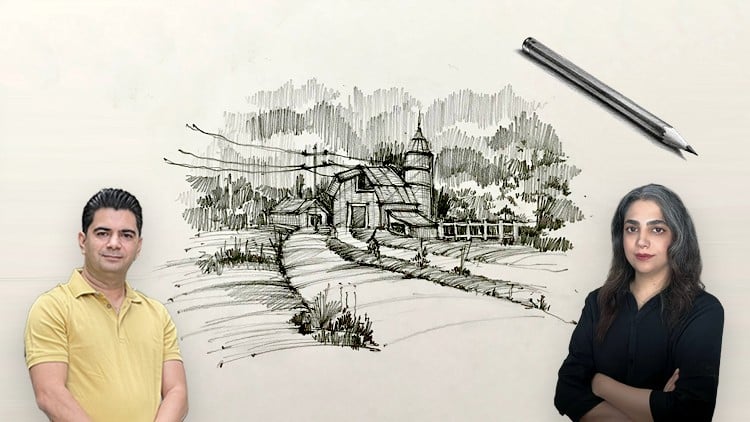
Get sketch lines, shading, hatching, and perspectives.Perfect for architecture, urban design and graphic design students
What you will learn
Master the fundamentals of architectural sketching – understand the role of sketching in design and how to use it as a powerful visualization tool.
Draw confident sketch lines and croquis lines – learn the differences, applications, and techniques to improve line quality.
Improve hand sketching control through structured exercises with curves, parallels, and freehand drawing practices.
Apply shading and hatching techniques to represent light, shadow, textures, and depth in architectural drawings.
Build confidence as a designer by transforming from a simple observer into a creative professional who can communicate ideas clearly on paper.
Add-On Information:
Note➛ Make sure your 𝐔𝐝𝐞𝐦𝐲 cart has only this course you're going to enroll it now, Remove all other courses from the 𝐔𝐝𝐞𝐦𝐲 cart before Enrolling!
- Explore the Essential Toolkit: Discover the fundamental sketching tools and materials, from various pencil grades to different paper types, understanding their unique properties and best uses for architectural representation.
- Master Basic Geometric Forms in Perspective: Learn to accurately render fundamental shapes like cubes, cylinders, and cones in both one-point and two-point perspective, forming the bedrock for sketching more complex architectural structures.
- Grasp Principles of Scale and Proportion: Develop an intuitive understanding of how to depict the relative size of objects and architectural elements, ensuring your drawings communicate realistic spatial relationships and human scale.
- Compose Compelling Visuals: Acquire techniques for effective composition, learning how to arrange elements within your sketch to create balanced, dynamic, and visually engaging architectural scenes.
- Practice Observational Sketching: Hone your ability to sketch from real-world observation, translating three-dimensional spaces, buildings, and urban environments onto paper with increasing accuracy and expressive quality.
- Cultivate Your Unique Artistic Voice: Begin to experiment with different line weights, textures, and approaches, fostering the development of a personal sketching style that reflects your individual interpretation and creativity.
- Integrate Contextual Elements: Learn simplified methods for incorporating essential contextual elements such as human figures, vehicles, and various types of foliage to add life, scale, and narrative depth to your architectural sketches.
- Utilize Sketching for Rapid Ideation: Discover how to leverage quick, freehand sketches as a powerful tool for brainstorming and rapidly exploring multiple design concepts, making design iterations more agile and intuitive.
- Understand Light and Shadow Dynamics: Develop an eye for identifying and consistently applying a single light source to your drawings, enabling you to create convincing shadows and highlights that define form and add drama.
- Employ Perspective Grids for Accuracy: Learn practical methods for setting up simple perspective grids as a guide, ensuring precision and structural integrity in your more intricate architectural drawings.
- Represent Diverse Architectural Textures: Gain proficiency in depicting a range of common building materials—like brickwork, wood grain, glass reflections, and concrete surfaces—using various cross-hatching and rendering techniques.
- Craft Narrative Through Your Drawings: Explore how to infuse your architectural sketches with a sense of atmosphere and story, transforming mere representations into compelling visual narratives that evoke emotion and context.
- Pros:
- Accessible and Zero-Cost: As a free course, it eliminates financial barriers, making quality foundational architectural sketching education available to a wider audience globally.
- Strong Foundational Skill Set: Provides a robust understanding of core sketching principles, equipping beginners with essential techniques directly applicable to architectural and design practices.
- Enhanced Visual Communication: Significantly improves your ability to articulate and convey complex design ideas quickly and clearly, fostering better collaboration and understanding among peers and clients.
- Boosts Observational Skills: Trains the eye to perceive and interpret the world in a more analytical and artistic way, enhancing overall design sensitivity and spatial awareness.
- Flexible and Self-Paced Learning: Typically, free online courses offer the flexibility to learn at your own pace and schedule, making it easier to integrate skill development into busy routines.
- Cons:
- Limited Personalized Feedback: As a free offering, direct one-on-one critique from an instructor is likely minimal or absent, which can be a significant drawback for developing artistic skills that often benefit greatly from tailored guidance.
English
language