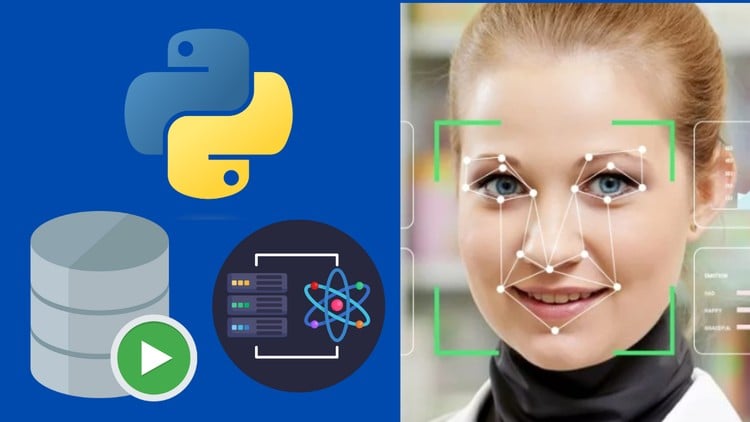
Face Recognition Attendance System Step-by-Step | Real Face Recognition Attendance Project | Face Recognition 2025
Why take this course?
🎓 Course Title: Complete Face Recognition Attendance System Using KNN & OPENCV
🌟 Course Description:
Embark on a fascinating journey into the world of Artificial Intelligence with our “Complete Face Recognition Attendance System Using KNN” course! This isn’t just another online course—it’s a deep dive into one of the most innovative technologies shaping our future. By leveraging the power of K-Nearest Neighbors (KNN) and OpenCV, you will build a robust face recognition attendance system from scratch.
This course is meticulously designed for learners who aspire to master face recognition technology, which has become integral to various sectors, including security, education, and more. As you progress, you’ll gain hands-on experience with real-world applications, culminating in a fully functional attendance system capable of recognizing and recording individuals with remarkable accuracy.
🚀 Class Overview:
Our comprehensive curriculum is structured to take you through each step of developing a face recognition attendance system. Here’s what you can expect:
- Introduction to Face Recognition Technology: 📚
- Understand the foundational concepts and real-world applications of face recognition technology.
- Explore a variety of face recognition algorithms and analyze their respective strengths and weaknesses.
- Setting Up the Development Environment: 🛠️
- Install essential libraries like OpenCV and scikit-learn for implementing face recognition and KNN algorithms.
- Get your development environment ready and kickstart your project by creating a new directory.
- Data Collection and Preprocessing: 📸
- Gather a diverse dataset of face images to train your system.
- Preprocess these images to ensure they’re uniform in size, shape, and quality for accurate recognition.
- Feature Extraction and Representation: 🔍
- Discover techniques for extracting relevant facial features using PCA or LBP.
- Learn how to transform these features into vectors suitable for the KNN algorithm’s input.
- Implementing the KNN Algorithm: 🧩
- Delve into the mechanics of the KNN algorithm and its role in classification tasks.
- Implement the KNN algorithm effectively using Python and the scikit-learn library.
- Training and Evaluation: 📊
- Segment your dataset into training and testing sets for robust learning.
- Train your KNN classifier and evaluate its performance with metrics like accuracy, precision, and recall.
- Integration with Attendance System: 🖥️
- Build a user-friendly GUI interface to interact with the attendance system.
- Seamlessly integrate the trained KNN classifier into your system for real-time face recognition and attendance tracking.
- Testing and Deployment: 🚀
- Test your face recognition attendance system under various conditions to ensure its reliability.
- Deploy your system in a live environment, ready to be used by educational institutions, businesses, or any organization looking to enhance their attendance management process.
By enrolling in this course, you’re not just learning a new skill—you’re empowering yourself with the knowledge to impact real-world problems using cutting-edge technology. Don’t wait; dive into the “Complete Face Recognition Attendance System Using KNN” course today and be at the forefront of the AI revolution! 🌟
Enroll now and start your transformation into a face recognition expert! 🚀💪
Course Overview
- This course provides an immersive, project-centric journey into building a robust face recognition attendance system using cutting-edge machine learning techniques.
- You’ll move beyond theoretical concepts to construct a tangible, functional application that automates the laborious process of attendance tracking.
- Explore the intricate architecture behind modern facial recognition, understanding how machines interpret and distinguish human faces in real-time.
- Focus on practical implementation strategies, ensuring you gain the confidence to develop and customize AI-powered solutions for various computer vision challenges.
- Prepare to dive into a hands-on experience, transforming raw data into intelligent systems that enhance efficiency and precision in real-world scenarios, marking a significant step in your AI journey for 2025 and beyond.
Requirements / Prerequisites
- Basic Python Programming: Familiarity with Python syntax, data structures, and fundamental programming concepts is essential to follow along with coding exercises.
- Conceptual Understanding of Data: A general grasp of data, its collection, and its importance in machine learning processes will be beneficial.
- Access to a Computer with Internet: You will need a personal computer capable of running Python and associated libraries, along with a stable internet connection.
- Webcam Access: A functioning webcam (built-in or external) is required for collecting live facial data and testing your attendance system.
- Curiosity for AI: An eagerness to learn and apply artificial intelligence to solve practical problems will greatly enhance your learning experience.
Skills Covered / Tools Used
- Python Ecosystem Mastery: Gain proficiency in key Python libraries such as OpenCV for computer vision tasks, scikit-learn for machine learning, and NumPy for numerical operations.
- Image Preprocessing Techniques: Learn advanced methods for preparing raw image data, including resizing, cropping, grayscale conversion, and normalization, crucial for model performance.
- Feature Engineering for Faces: Develop an intuition for extracting and representing unique facial features that enable accurate differentiation between individuals.
- Machine Learning Workflow: Understand the end-to-end process of an ML project, from data acquisition and model training to evaluation and deployment considerations.
- Computer Vision Fundamentals: Acquire a solid foundation in how computers ‘see’ and interpret visual information, specifically within the context of human faces.
- Ethical AI Development: Discuss the critical ethical implications and best practices associated with developing and deploying face recognition technologies responsibly.
- Project Structuring & Management: Learn to organize and manage a machine learning project, from initial setup to final output, simulating a real-world development environment.
Benefits / Outcomes
- Build a Portfolio-Ready Project: Conclude the course with a fully functional face recognition attendance system, an impressive addition to your professional portfolio.
- Enhanced Computer Vision Expertise: Develop a profound understanding of how to apply machine learning to complex image analysis and recognition tasks.
- Practical AI Application Skills: Gain hands-on experience in implementing AI solutions to automate mundane tasks and improve operational efficiency.
- Problem-Solving with AI: Sharpen your ability to conceptualize, design, and execute AI projects from scratch, tackling real-world challenges with intelligent systems.
- Career Advancement in AI/ML: Position yourself for roles in computer vision, machine learning engineering, or AI development with practical, sought-after skills.
- Deepened ML Model Understanding: Understand the nuances of model selection, training, and optimization specifically for image-based classification tasks.
PROS
- Creates a tangible, real-world project for your portfolio, demonstrating practical ML application.
- Provides extensive practical experience with in-demand AI technologies and tools.
- Step-by-step guidance ensures comprehensive understanding and successful project completion.
- Empowers you to automate processes using intelligent, vision-based systems.
- Leverages widely used open-source machine learning and computer vision libraries.
- Offers insights into the ethical considerations of AI deployment, fostering responsible development.
CONS
- Successful deployment and ongoing maintenance of face recognition systems can pose significant ethical, privacy, and security challenges, requiring careful consideration beyond technical implementation.