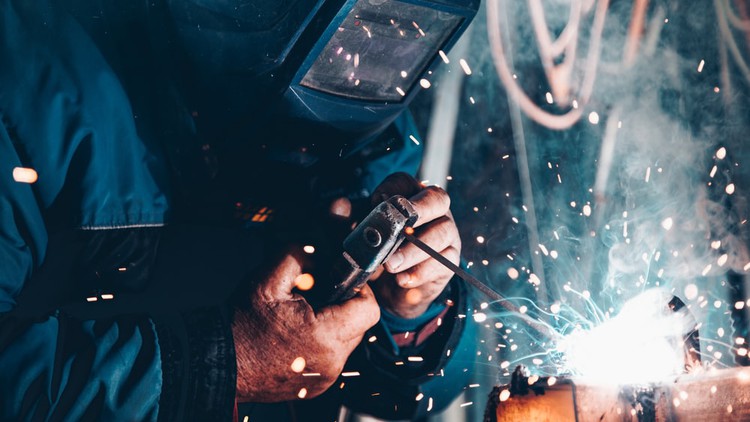
Course for the Students of Manufacturing Engineering or those who want to prepare for the Welding Technology Interview.
What you will learn
Understand about the history of welding in details that you can from where this technology start from..
Understand difference between joining and welding with the advantages and disadvantages of welding.
Get idea about the components used in welding ( Consumable and Non Consumable) .
Understand all type of welding joints and type of welds.
Welding as commercial operations and the safety requirement for the welding processes.
Understand in detail about the arc and the shield welding processes.
Deeply Understand all type of welding processes that are used in industries.
Understand about the solid state welding and its types and defects.
Understand all the concepts about the soldering and brazing processes.
Description
This course is designed for the students of Mechanical and Processing Engineers who want to learn all the welding processes for their Examination point of for or for the Students who want to prepare them for the Welding Interview as this course covers all the welding processes in detail. This Course Includes the following topics.
Introduction and Fundamentals of the Welding Process and Welding Safety
- Fundamentals of welding
- Difference between joining and welding
- Advantages and Disadvantages of Welding
- History of welding
- Types of the welding process
- Components used for welding process (Filler material, Flux, and Electrolyte)
- Consumable and Non-consumable electrolyte
- Welding positions
- Welding Electrode Nomenclature
- Type of Weld Joints (Butt joint, Corner Joint, Lap joint, Tee Joint, Edge Joint)
- Types of Weld (Filler Weld, Groove Weld, Plug weld or slot weld, Spot and Seam weld, Flange and Surface Weld)
- Features of Fusion Welded Joints
- Physics of welding (Power Density and Numerical of Power Density)
- Heat Balance in Fusion Welding
- Welding as Commercial Operation
- Automation in Welding (Machine, Automatic and Robotic)
- Welding Safety
Arc Welding and Shielding and Types of Arc Welding
Welding Categories (Fusion Welding, Solid State Welding, Soldering and Brazing)
Arc Welding
Arc Shielding
The power source in Arc welding
Types of Arc Welding (Shielding metal arc welding, Gas Metal Arc Welding, Flux Cored Arc Welding, Submerged Arc Welding)
Gas Tungsten welding
Plasma arc welding
Understand all Types of Welding in Detail
- Oxyfuel arc welding
- Oxyacetylene welding
- Resistance welding
- Spot Welding
- Resistance seam welding
- Resistance projection welding
- Energy beam welding (Electron beam welding, Laser beam welding)
- Numerical Problems related to the welding processes
Numerical Problems Related to the Welding Processes
- Numerical Problems Related to the welding processes
Solid-State Welding with Types and Defects, Brazing and Soldering
- Solid-state welding
- Types of solid-state welding
- (Diffusion welding, Friction welding, and Ultrasonic welding)
- Welding Defects of Solid State Welding
- Brazing and Soldering
Successful graduates of the Welding Technology certificate can be employed as entry-level technicians in the welding and metalworking industries. Career opportunities also exist in construction, manufacturing, fabrication, sales, quality control, and welding-related self-employment.
Content
- Course Caption: Course for the Students of Manufacturing Engineering or those who want to prepare for the Welding Technology Interview.
Course Overview
- This specialized certification program is meticulously crafted for engineers aiming to master the intricacies of welding quality assurance and inspection, culminating in preparation for the Certified Welding Inspector (CWI) examination.
- Delve into the engineering principles underpinning various welding technologies, focusing on their application, control, and validation in industrial settings.
- Bridge the gap between theoretical knowledge of welding processes and the practical requirements of ensuring structural integrity, reliability, and code compliance.
- Understand the critical role of the CWI in fabrication, construction, and repair, emphasizing decision-making based on industry standards and specifications.
Requirements / Prerequisites
- A foundational engineering degree or strong academic background in Manufacturing, Mechanical, Metallurgical, Materials Science, or a related field.
- Prior exposure to basic materials science concepts and mechanical properties is highly recommended.
- Analytical thinking skills and a detail-oriented approach are essential for grasping complex code interpretations and inspection methodologies.
- A commitment to rigorous study and a desire to achieve professional certification in welding technology.
Skills Covered / Tools Used
- Interpreting and applying a broad spectrum of national and international welding codes, standards, and specifications (e.g., AWS D1.1, ASME Section IX).
- Proficiency in reviewing and approving Welding Procedure Specifications (WPS), Procedure Qualification Records (PQR), and Welder Performance Qualifications (WPQ).
- Developing a keen eye for visual inspection, identifying critical weld discontinuities, imperfections, and defects based on code criteria.
- Understanding the principles and applications of various Non-Destructive Testing (NDT) methods like Radiographic Testing (RT), Ultrasonic Testing (UT), Magnetic Particle Testing (MT), and Liquid Penetrant Testing (PT) from an inspector’s perspective.
- Skill in using precision measuring gauges and templates essential for verifying weld dimensions, fit-up, and conformity.
- Executing inspection plans, documenting findings, and generating comprehensive inspection reports that meet industry standards.
Benefits / Outcomes
- Significantly enhance your credentials and marketability in high-demand industries such as oil & gas, aerospace, construction, automotive, and power generation.
- Acquire the specialized knowledge and confidence to successfully challenge the demanding CWI examination, opening doors to advanced career opportunities.
- Develop the expertise to ensure the quality, safety, and reliability of welded structures and components, mitigating risks and optimizing operational performance.
- Gain the authority to approve or reject welding procedures and personnel, contributing directly to project success and adherence to regulatory requirements.
- Elevate your understanding of welding from a purely process-oriented view to a comprehensive engineering and quality assurance perspective.
- Position yourself as a critical asset in roles involving quality control, fabrication management, supplier surveillance, and failure analysis.
PROS
- Industry-Recognized Credential: The CWI certification is globally respected, significantly boosting your professional standing and career trajectory.
- High Earning Potential: Certified Welding Inspectors are in high demand, commanding competitive salaries across various sectors.
- Career Versatility: The skills acquired are applicable in a vast array of industries, offering diverse career paths and job security.
- Enhanced Problem-Solving: Develop a rigorous approach to identifying, analyzing, and resolving complex welding-related issues.
- Leadership Opportunities: Qualifies you for supervisory and management roles in quality assurance and fabrication.
CONS
- Requires significant dedication and rigorous study to master the extensive material and pass the challenging CWI examination.