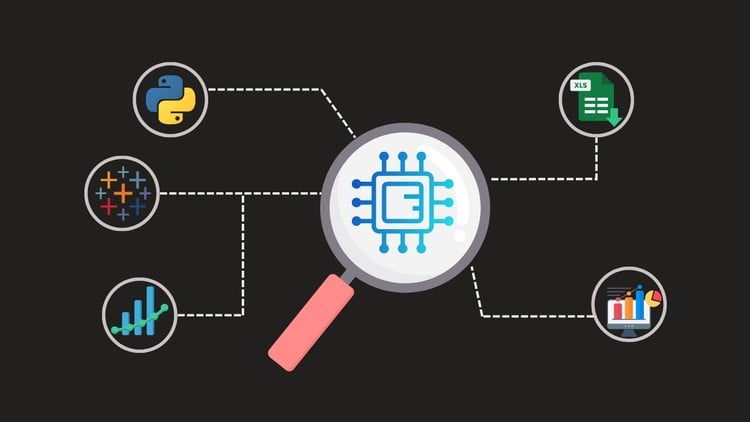
A beginner-friendly data science course covering Excel, Python, Tableau, and statistics with real-world projects.
What you will learn
Analyze and visualize data in Excel using pivot tables and charts.
Write Python scripts for data manipulation with Pandas and NumPy.
Perform statistical analysis and hypothesis testing with ease.
Create interactive dashboards and visualizations in Tableau.
Clean, organize, and prepare datasets for analysis.
Understand key statistical concepts for data-driven decisions.
Use Python libraries like Matplotlib and Seaborn for visualization.
Integrate Excel, Python, and Tableau for seamless data workflows.
Apply real-world data analysis techniques to projects.
Build confidence as a data science professional from scratch.
The Reality of the 2025 Data Landscape: An Honest Overview
Let’s be real for a second—the market is flooded with “Data Science” courses that promise you a six-figure salary after learning three lines of code. It’s exhausting. However, Data Science Mastery 2025: Excel, Python & Tableau caught my eye because it doesn’t try to sell the “AI magic” dream immediately. Instead, it focuses on the actual industry-standard tools that keep modern businesses running. Having spent over a decade in the tech space, I’ve seen plenty of juniors fail because they can write a complex neural network but can’t build a simple Pivot Table to answer a CFO’s question in five minutes.
This course treats data science as a workflow, not just a set of isolated skills. It acknowledges that in the real world, your data is often messy, stuck in an Excel sheet, and needs to be cleaned with Python before being presented in a high-stakes meeting via Tableau. This isn’t just about learning syntax; it’s about career growth and developing job-ready skills that actually translate to a paycheck. It’s a pragmatic deep dive into the “Full Stack” of data analysis, making it a solid certification prep path for those looking to pivot into the field without losing their minds in academic jargon.
Who Should Actually Sign Up? (Prerequisites)
The beauty of this curriculum is the low barrier to entry, but don’t mistake “beginner-friendly” for “easy.” You don’t need a PhD in Mathematics or a Computer Science degree to get started. If you know how to open a spreadsheet and have a basic grasp of logical thinking (if-this-then-that), you’re ready. The course is designed for career switchers, recent grads, or even mid-level managers who want to stop relying on their analytics team for every small report. It’s built from beginner to advanced, so as long as you have a laptop and the patience to troubleshoot a few Python scripts, you’re qualified.
The Toolkit: Industry-Standard Skills & Tools
The curriculum is strategically partitioned to mirror a real-world project lifecycle. You’ll spend significant time mastering the following:
- Advanced Excel: Moving beyond simple sums into data manipulation, lookup functions, and sophisticated Pivot Tables for rapid prototyping.
- Python for Data Science: You’ll get your hands dirty with Pandas and NumPy. This is where you learn to automate the boring stuff and handle datasets too large for Excel to breathe.
- Statistical Analysis: This isn’t a boring math lecture. It’s hands-on labs focused on hypothesis testing and data-driven decision-making.
- Data Visualization: Using Matplotlib and Seaborn for technical plots, and then moving into Tableau for creating interactive dashboards that non-tech stakeholders can actually understand.
- Data Cleaning & Preprocessing: Perhaps the most vital skill—learning how to handle missing values and “dirty” data, which accounts for 80% of a data professional’s job.
Career Benefits & Job Roles
Completing this course doesn’t just add a line to your LinkedIn; it builds a professional portfolio. In the current economy, employers are looking for Data Analysts, Business Intelligence (BI) Developers, and Data Strategists who can demonstrate real-world data analysis capabilities. By integrating Excel, Python, and Tableau, you position yourself as a versatile asset.
The ROI on this type of training is usually high because these roles are central to digital transformation across every sector—from healthcare to fintech. You’re not just learning to code; you’re learning to provide business intelligence that drives revenue. Whether you are aiming for a promotion or a total career pivot, the focus on job-ready skills ensures you can hit the ground running on day one of a new role.
What I Liked (The Pros)
- The Integrated Workflow: Most courses teach Python in a vacuum. This course shows you how to pull data from Excel, clean it in a Jupyter Notebook, and push the results to Tableau. That’s how the job actually works.
- Focus on Storytelling: The Tableau modules are excellent. They don’t just teach you where to click; they teach you why a certain visualization works for your audience.
- Hands-on Labs: You aren’t just watching videos. The real-world projects involve messy datasets that require actual thought, which is the best way to build confidence as a data science professional.
- Modern Tooling: Everything is updated for 2025, meaning no outdated libraries or deprecated Python syntax that crashes your environment.
The Reality Check (The Cons)
If I’m being completely honest, the statistical analysis section can feel a bit rushed if you have zero background in math. While it’s “easy” to perform the tests using Python libraries, the deep theoretical “why” behind some of the more complex hypothesis testing might require you to do some outside reading if you want to be a true statistics nerd. It’s perfect for practitioners, but maybe a bit light for those wanting to go into heavy academic research.
Overall, if you want a hands-on, no-nonsense path to becoming job-ready in the data space, this is one of the most coherent packages I’ve seen this year. It skips the fluff and gives you the industry-standard tools you need to actually get hired.