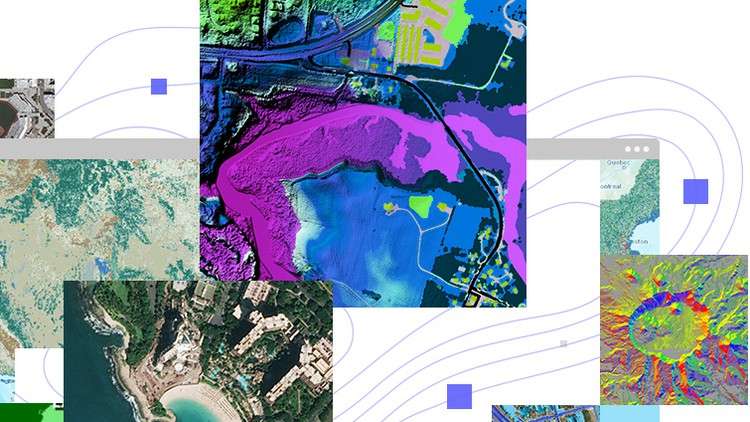
Embark on an exciting journey into the world of ArcGIS Pro with our video course, “Exploring ArcGIS Pro.”
What you will learn
Students will demonstrate proficiency in accessing and utilizing various features and functionalities of the ArcGIS Pro interface, including the Home screen.
Students will be able to georeference raster images using control points accurately, ensuring spatial alignment and referencing to real-world coordinates.
Students will demonstrate proficiency in using tools such as Export, Merge, Mosaic, Clip, and Extract by Mask to manipulate and export spatial data efficiently
Students will be able to generate and interpret different types of maps, including slope maps, contour maps, and hillshade maps.
Why take this course?
Embark on an exciting journey into the world of ArcGIS Pro with our video course, “Mastering ArcGIS Pro.” This course is designed for everyone, from beginners to experienced GIS professionals, and covers everything from the basics to advanced geospatial analysis.
Start by exploring the ArcGIS Home Screen and learn how to create a new project step by step. Understand the project interface to efficiently organize and manage geospatial data within the ArcGIS Pro environment. Dive into geoferencing to align raster images with real-world coordinates using control points.
Test your skills with practical evaluations and move on to explore various tools for geospatial analysis. Gain hands-on experience with the Export Tool, where you’ll convert and export shapefiles. Learn about merging, mosaic raster, clip, and extract by mask tools through real-world scenarios.
Throughout the course, assess your progress with tests and gain insights into exporting geospatial files in different formats. Explore effective data management using tools like Dissolve, Union, and Intersect for shapefile management and integration.
Delve into elevation data in both 2D and 3D environments, covering contours, contour maps, hillshade, and slope for terrain analysis.
Explore land cover analysis with different indices like NDVI, NDBI, and MNDWI, applying mathematical formulations and tools for calculation.
By the end of this course, you’ll have a strong skill set in utilizing ArcGIS Pro for geospatial analysis and data manipulation across various applications. Whether you’re a beginner or an experienced GIS professional, this course provides the knowledge and practical skills to excel in the world of geospatial technology.
Alright folks, gather ’round. If you’re in the geospatial game, or looking to break in, you’ve probably heard the whispers about ArcGIS Pro. It’s the big kahuna, the industry standard, and let’s be honest, it can be a bit intimidating when you first crack it open. That’s where a solid course like “Exploring ArcGIS Pro: GIS Tutorials from Basics to Advanced” comes in. I recently dove into this one, and I’ve got some unfiltered thoughts for you.
Overview
This course is pitched as a comprehensive journey, and I’d say it largely delivers. It’s not just about clicking buttons; it’s about building a foundational understanding of ArcGIS Pro‘s ecosystem. What I appreciated right off the bat was its logical progression. They don’t just throw advanced geoprocessing tools at you without making sure you’ve got a grip on the interface. The early modules do a commendable job of demystifying the ribbon, the catalog pane, and how to navigate around your data. It sets a good stage for the more complex topics that follow. Think of it as your guided tour of a sprawling digital landscape before you start mapping it yourself.
Prerequisites
Honestly? Not much beyond a willingness to learn and a decent internet connection. While they don’t explicitly state it, having some fundamental understanding of what a Geographic Information System (GIS) is will certainly help. If you’ve dabbled in QGIS or any other GIS software before, you’ll be ahead of the curve. But even if you’re coming in cold, the course is designed to bring you up to speed. A computer that can handle some graphical processing is a must, as ArcGIS Pro isn’t exactly a lightweight application.
Skills & Tools
This course is practically a checklist for getting job-ready skills in ArcGIS Pro. You’ll be getting hands-on experience with:
- Mastering the ArcGIS Pro interface, from the Home screen to project management.
- Accurate georeferencing of raster images – a crucial skill for integrating scanned maps or aerial photos into your digital workflows.
- Efficient spatial data manipulation using essential tools like Export, Merge, Mosaic, Clip, and Extract by Mask. These are the workhorses for preparing data for analysis.
- Generating and interpreting various topographic and thematic maps, including slope maps, contour maps, and hillshade maps. This is where the visualization and interpretation power of GIS really shines.
It’s a solid blend of fundamental operations and analytical map generation. The emphasis on these core competencies makes it a great starting point for anyone looking to get a handle on industry-standard tools.
Career Benefits & Job Roles
Let’s talk brass tacks: career growth. Possessing proficiency in ArcGIS Pro is a significant asset in the job market. This course directly contributes to building job-ready skills that are sought after across a multitude of industries. Think urban planning, environmental science, natural resource management, emergency services, and even market research. The ability to manipulate, analyze, and visualize spatial data with a tool like ArcGIS Pro opens doors to roles such as GIS Analyst, GIS Technician, Cartographer, Spatial Data Scientist, and even Project Manager in GIS-intensive fields. It’s also excellent certification prep if you’re eyeing Esri’s own credentials.
Pros
- Comprehensive Coverage: It genuinely takes you from a blank slate to being able to perform meaningful spatial analysis and map creation. The jump from basic interface navigation to generating advanced maps feels natural.
- Hands-on Approach: The focus on practical application and the use of hands-on labs (implied through the tutorial format) is where the real learning happens. You’re not just watching; you’re doing.
- Real-World Relevance: The skills you acquire are directly transferable to real-world projects and the demands of the professional GIS landscape. No fluff here.
Cons
My main gripe, and it’s a persistent one with many introductory courses, is that while it covers a lot, the depth of some of the more advanced analytical techniques could be expanded. For instance, while you learn to *generate* slope maps, the deeper dive into interpretative hydrology or advanced terrain analysis using those outputs might be a topic for a subsequent, more specialized course. It’s an excellent foundation, but don’t expect to become an Esri guru overnight from this single course alone.