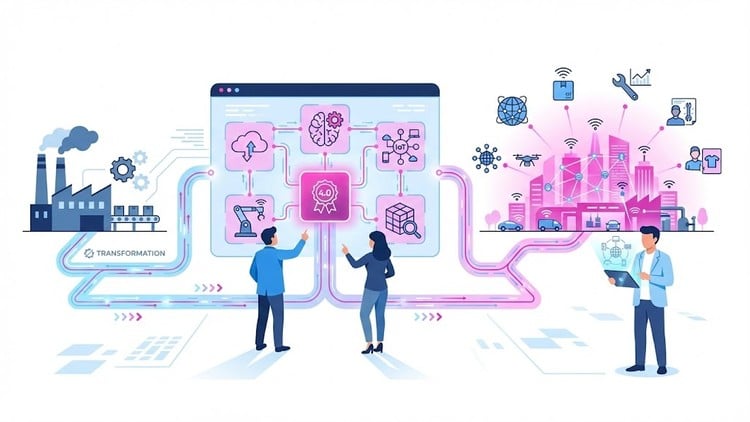
Explore the foundations, challenges, and transformative impacts of Industry 4.0 in contemporary industrial environments.
⏱️ Length: 31 total minutes
⭐ 4.31/5 rating
👥 1,927 students
🔄 July 2024 update
Add-On Information:
Note➛ Make sure your 𝐔𝐝𝐞𝐦𝐲 cart has only this course you're going to enroll it now, Remove all other courses from the 𝐔𝐝𝐞𝐦𝐲 cart before Enrolling!
- Course Overview
- Embark on a concise yet potent journey into the heart of the Fourth Industrial Revolution, dissecting its core tenets and the technological underpinnings that are redefining global manufacturing and operations.
- This course serves as a critical gateway for professionals and aspiring innovators seeking to grasp the paradigm shift brought about by interconnected, intelligent, and automated industrial systems.
- Navigate the conceptual landscape of Industry 4.0, moving beyond buzzwords to understand its tangible applications and the strategic imperative for adoption in today’s competitive arena.
- Discover how the confluence of digital and physical realms is creating unprecedented opportunities for efficiency, agility, and data-driven decision-making within industrial settings.
- The rapid evolution of industrial processes demands a forward-thinking approach, and this course equips you with the foundational knowledge to navigate this transformative period with confidence.
- Core Themes Explored
- Uncover the driving forces behind the current industrial transformation, examining the historical context of automation and digitalization that paved the way for Industry 4.0.
- Delve into the fundamental technologies powering this revolution, including the Internet of Things (IoT), artificial intelligence (AI), machine learning (ML), big data analytics, cloud computing, and advanced robotics.
- Understand the concept of the ‘smart factory’ as the physical manifestation of Industry 4.0, where machines, systems, and humans collaborate seamlessly through intelligent networks.
- Explore the ethical considerations and societal implications arising from widespread industrial automation and data utilization.
- Gain insights into the economic and competitive advantages that can be unlocked by embracing Industry 4.0 principles and practices.
- Practical Applications and Case Studies
- Witness firsthand how Industry 4.0 is revolutionizing diverse sectors, from automotive and aerospace to healthcare and consumer goods, through real-world examples.
- Analyze the strategic implementation of IoT sensors, digital twins, and predictive maintenance algorithms to optimize production lines and minimize downtime.
- Investigate the role of AI and ML in enhancing quality control, supply chain management, and personalized product development.
- Examine how data analytics is becoming the cornerstone of operational intelligence, enabling proactive problem-solving and continuous improvement.
- Understand the challenges encountered during Industry 4.0 adoption, such as cybersecurity threats, data privacy concerns, workforce upskilling, and integration complexities.
- Requirements / Prerequisites
- A foundational understanding of general business principles and operations is beneficial but not strictly required.
- Familiarity with basic technological concepts, such as the internet and software applications, will enhance the learning experience.
- An open mind and a willingness to engage with complex, evolving technological paradigms are essential.
- No prior expertise in advanced engineering or programming is necessary to grasp the core concepts presented.
- This course is designed for a broad audience, from business leaders and managers to engineers and students interested in the future of industry.
- Skills Covered / Tools Used
- Development of strategic thinking regarding digital transformation initiatives.
- Enhanced analytical skills for interpreting industrial data and trends.
- An understanding of the interplay between various Industry 4.0 technologies and their synergistic effects.
- Improved conceptualization of interconnected systems and their operational dynamics.
- Familiarity with frameworks and models that guide Industry 4.0 adoption.
- Benefits / Outcomes
- Acquire the knowledge to identify opportunities for technological integration and process optimization within your organization.
- Become a more informed decision-maker regarding investments in Industry 4.0 solutions.
- Gain the confidence to discuss and implement Industry 4.0 strategies effectively.
- Position yourself at the forefront of industrial innovation and technological advancement.
- Enhance your career prospects in a rapidly digitizing global economy.
- PROS
- Concise and Efficient: Delivers essential knowledge within a compact timeframe, ideal for busy professionals.
- High Relevance: Directly addresses a critical and rapidly evolving field impacting all industries.
- Accessible Content: Designed for a wide audience, making complex topics understandable without extensive technical background.
- Practical Insights: Incorporates real-world examples and case studies to illustrate theoretical concepts.
- Up-to-Date: Regularly updated to reflect the latest developments in July 2024.
- CONS
- Limited Depth: Due to its brevity, it may not provide exhaustive detail on highly specialized technical aspects of Industry 4.0 technologies.
Learning Tracks: English,Business,Industry
Found It Free? Share It Fast!