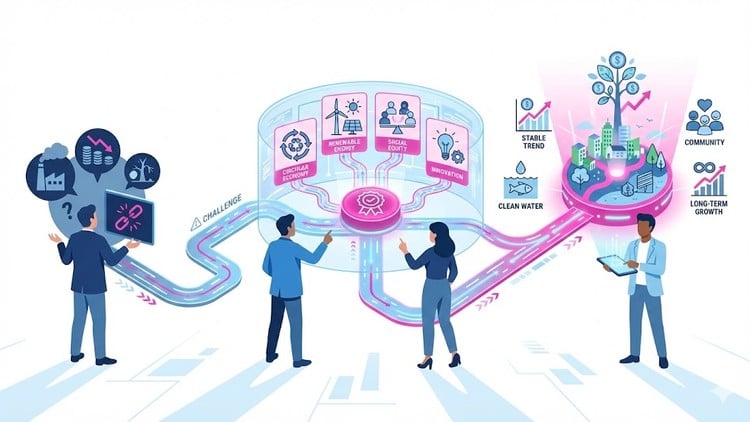
“Learn how economic activities impact our environment and society, and explore sustainable solutions.”
⏱️ Length: 1.3 total hours
⭐ 5.00/5 rating
👥 476 students
🔄 July 2024 update
Add-On Information:
Note➛ Make sure your 𝐔𝐝𝐞𝐦𝐲 cart has only this course you're going to enroll it now, Remove all other courses from the 𝐔𝐝𝐞𝐦𝐲 cart before Enrolling!
- Course Overview
- Embark on a concise 1.3-hour journey to grasp the intricate relationship between economic practices, ecological well-being, and societal progress.
- This course is meticulously crafted for the curious mind, offering a 5/5 rated learning experience with over 476 students enrolled as of July 2024.
- Gain a foundational understanding of how economic systems are inherently intertwined with the planet’s health and the fabric of human communities.
- Discover the compelling narratives of businesses and policies that are pioneering innovative approaches to economic development.
- Explore the multifaceted challenges and exciting opportunities presented by the pursuit of a truly sustainable economic model.
- This introductory module provides a panoramic view of the field, setting the stage for deeper dives into specific aspects of economic sustainability.
- Understand the evolving landscape of global economics through the lens of long-term viability and ethical considerations.
- We will explore the concept of the “triple bottom line” and its practical implications for organizations of all sizes.
- The course emphasizes the interconnectedness of global supply chains and their impact on diverse ecosystems and communities.
- Learn about the principles of circular economy and how they contrast with traditional linear economic models.
- Gain insights into the role of innovation and technology in driving sustainable economic solutions.
- Appreciate the importance of policy frameworks and regulatory measures in shaping sustainable economic futures.
- Key Themes Explored
- The Economic Paradox of Growth: Investigate how traditional economic growth metrics may obscure hidden environmental and social costs.
- Resource Scarcity and Economic Resilience: Examine how diminishing natural resources present both challenges and opportunities for economic adaptation.
- Externalities and Market Failures: Understand how unpriced environmental and social consequences can lead to inefficient economic outcomes.
- Green Economy Transitions: Explore the sectors and industries at the forefront of developing sustainable economic models.
- Social Justice and Economic Development: Analyze the critical link between equitable distribution of wealth and a sustainable economic future.
- Behavioral Economics of Sustainability: Discover how psychological factors influence individual and collective decision-making regarding sustainable choices.
- The Role of Finance in Sustainability: Learn about sustainable investment, green bonds, and the evolving financial landscape.
- Measuring What Matters: Go beyond GDP to explore alternative indicators of economic progress that encompass well-being and planetary health.
- Corporate Social Responsibility (CSR) in Practice: Delve into real-world examples of companies integrating sustainability into their core strategies.
- Global Cooperation for Sustainable Economies: Understand the importance of international collaboration in addressing shared economic and environmental challenges.
- Ethical Consumption and Production: Examine the power of consumer choices and business practices in driving sustainable change.
- Future Economic Scenarios: Envision plausible pathways for economies that prioritize long-term flourishing over short-term gains.
- Requirements / Prerequisites
- No formal academic prerequisites are required; a curious and open mind is the primary requirement.
- Basic literacy and the ability to engage with written and visual course materials.
- Access to a stable internet connection for online delivery.
- A willingness to critically engage with complex and sometimes controversial economic concepts.
- Familiarity with general economic principles is beneficial but not strictly necessary.
- An interest in global issues, environmental concerns, and social equity.
- Skills Covered / Tools Used
- Critical Analysis: Develop the ability to dissect economic arguments and identify underlying assumptions.
- Systems Thinking: Understand how different economic, social, and environmental factors interact.
- Problem-Solving: Learn to identify challenges and conceptualize potential sustainable solutions.
- Information Synthesis: Integrate knowledge from various sources to form coherent perspectives.
- Ethical Reasoning: Apply ethical frameworks to economic decision-making.
- Case Study Analysis: Engage with real-world examples to deepen understanding.
- Conceptualization: Grasp abstract economic theories related to sustainability.
- Benefits / Outcomes
- Enhanced Global Awareness: Gain a comprehensive understanding of the interconnectedness of global economies and their impact.
- Informed Decision-Making: Equip yourself with the knowledge to make more sustainable personal and professional choices.
- Career Advancement: Open doors to roles and industries increasingly focused on sustainability and responsible business practices.
- Empowered Citizenship: Become a more informed and engaged participant in discussions about economic policy and societal development.
- Personal Growth: Cultivate a deeper appreciation for the complexities of building a more equitable and resilient world.
- Foundation for Further Learning: Lay the groundwork for specialized studies in environmental economics, sustainable development, or corporate social responsibility.
- Improved Critical Thinking: Sharpen your ability to evaluate complex information and form well-reasoned conclusions.
- Contribution to a Better Future: Develop the capacity to contribute meaningfully to the transition towards a more sustainable global economy.
- PROS
- Concise and Accessible: Ideal for busy individuals seeking a foundational understanding without a significant time commitment.
- High Student Satisfaction: A proven track record with excellent ratings indicates effective teaching and valuable content.
- Up-to-Date Content: Regularly updated to reflect current trends and challenges in economic sustainability.
- Broad Applicability: Insights are relevant for students, professionals, and engaged citizens alike.
- Multi-faceted Approach: Covers environmental, social, and economic dimensions of sustainability.
- CONS
- Introductory Level: May not satisfy individuals seeking in-depth, specialized knowledge in advanced economic sustainability topics.
Learning Tracks: English,Business,Management
Found It Free? Share It Fast!