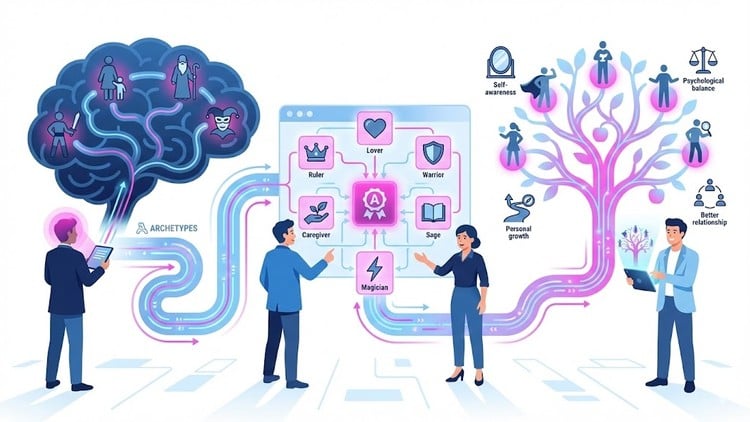
Explore the influence of archetypes on human behavior for personal growth and social dynamics.
⏱️ Length: 1.5 total hours
⭐ 4.33/5 rating
👥 1,023 students
🔄 June 2024 update
Add-On Information:
Note➛ Make sure your 𝐔𝐝𝐞𝐦𝐲 cart has only this course you're going to enroll it now, Remove all other courses from the 𝐔𝐝𝐞𝐦𝐲 cart before Enrolling!
- Course Overview
- Exploring the complex and often invisible interface between individual consciousness and the collective unconscious as defined by pioneering depth psychologists.
- Tracing the historical and evolutionary origins of universal symbols to understand why specific images and narratives recur across distinct global cultures.
- Deciphering the fundamental Archetypal Blueprints that dictate how humans perceive reality, process emotions, and react to external stressors.
- Investigating the internal hierarchy of the soul, focusing on the Ego, the Persona, and the Shadow to achieve psychological balance.
- Analyzing the modern manifestations of ancient myths within current digital media, cinematic trends, and social media personality branding.
- Examining the concept of the Hero’s Journey as a psychological roadmap for navigating personal crises and major life transitions.
- Understanding the Anima and Animus constructs to gain insight into the internal feminine and masculine energies that influence romantic attractions.
- Learning how the Wise Old Man and the Great Mother archetypes shape our expectations of authority figures and nurturing environments.
- Differentiating between personal complexes and universal archetypal patterns to better understand the root causes of repetitive behavioral cycles.
- Reviewing how archetypes serve as a bridge between the biological instincts of the body and the spiritual aspirations of the human mind.
- Requirements / Prerequisites
- A foundational curiosity regarding the hidden drivers of human motivation and a desire to look beneath the surface of everyday social interactions.
- A willingness to engage in radical self-reflection and the courage to confront the less desirable aspects of one’s own personality.
- No formal degree or prior background in clinical psychology, sociology, or behavioral science is required to grasp these concepts.
- Access to a private journal or digital document for completing archetypal mapping exercises and documenting recurring dream symbols.
- An open-minded approach toward non-linear psychological theories and symbolic interpretation that may differ from traditional cognitive-behavioral perspectives.
- A basic familiarity with general storytelling structures found in world literature, mythology, or modern popular film franchises.
- Skills Covered / Tools Used
- Archetypal Pattern Recognition: Developing the mental acuity to identify recurring mythic motifs in workplace hierarchies and family dynamics.
- Shadow Work Frameworks: Utilizing specific introspective tools to identify, acknowledge, and integrate repressed traits for wholistic personality development.
- Symbolic Deconstruction: Learning the art of interpreting dreams and creative outputs through a lens of psychological symbolism rather than literalism.
- Active Imagination Techniques: Engaging with internal archetypal figures through guided meditative prompts to resolve inner psychic tension.
- Interpersonal Dynamic Mapping: Applying the Archetypal Wheel to assess and improve communication styles within professional and personal relationships.
- Narrative Reframing: Using the power of story to shift one’s self-perception from a “Victim” archetype to a “Creator” or “Warrior” archetype.
- Projection Identification: Gaining the skill to recognize when internal archetypal expectations are being unfairly projected onto colleagues, friends, or partners.
- Archetypal Branding Analysis: Understanding how marketing and leadership use The Ruler or The Rebel archetypes to influence public perception.
- Benefits / Outcomes
- Achieving a profound state of Psychological Wholeness by harmonizing the various conflicting archetypal forces existing within the psyche.
- Enhancing overall Emotional Intelligence (EQ) through a sophisticated understanding of universal human vulnerabilities and core motivations.
- Developing superior storytelling and communication abilities by leveraging archetypal resonance in creative writing, marketing, or public speaking.
- Building greater Psychological Resilience during times of chaos by identifying with the “Sage” or “Seeker” archetypes to find meaning in struggle.
- Clarifying your unique life purpose by identifying your dominant personal archetype and aligning your career path with your inherent psychic structure.
- Improving conflict resolution skills by recognizing the archetypal “villains” or “martyrs” we often play in our own domestic or professional dramas.
- Cultivating a much richer and more meaningful internal life by establishing a conscious relationship with the symbols present in your subconscious mind.
- Developing the ability to predict human behavior patterns in high-stress environments by identifying which archetypes are currently “constellated” in a group.
- Gaining a sense of global connectivity by realizing that your individual struggles are part of the broader human experience shared across all history.
- Empowering the Self-Actualization process through the systematic removal of the “Persona” masks that no longer serve your true identity.
- PROS
- Provides a highly efficient 1.5-hour curriculum that distills complex Jungian theory into immediately applicable life strategies for busy learners.
- Boasts a strong social validation with a 4.33/5 student rating, indicating high satisfaction and practical utility across a broad audience.
- The June 2024 update ensures that all psychological references and cultural examples are relevant to the modern digital and social landscape.
- Features a diverse enrollment of over 1,000 students, fostering a sense of community for those interested in depth psychology and personal growth.
- Offers a unique multidisciplinary approach that blends traditional psychology with mythology, art history, and modern behavioral science.
- CONS
- Due to its concise format, the course serves primarily as a foundational introduction and may lack the granular clinical depth required by professional psychoanalysts or doctoral-level researchers seeking advanced case study analysis.
Learning Tracks: English,Personal Development,Influence
Found It Free? Share It Fast!