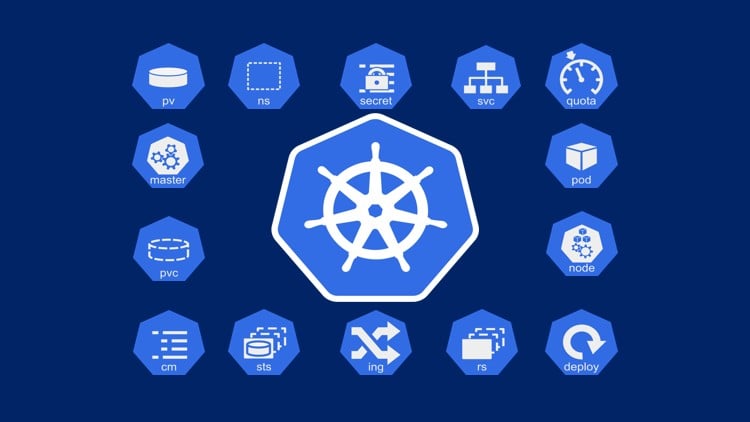
Master Pods, Deployments, ReplicaSets, StatefulSets, Services, Ingress & Volumes etc through Real-World Kubernetes Labs
⏱️ Length: 25.7 total hours
⭐ 4.80/5 rating
👥 2,071 students
🔄 June 2025 update
Add-On Information:
Note➛ Make sure your 𝐔𝐝𝐞𝐦𝐲 cart has only this course you're going to enroll it now, Remove all other courses from the 𝐔𝐝𝐞𝐦𝐲 cart before Enrolling!
- Course Overview
- Embark on a comprehensive journey to demystify and master the foundational elements of Kubernetes, the de facto standard for container orchestration.
- This course is meticulously designed for individuals eager to move beyond theoretical knowledge and dive headfirst into practical application, offering a substantial 25.7 hours of immersive, hands-on learning.
- With an impressive average rating of 4.80/5 and trusted by over 2,071 students, this program has been recently updated in June 2025 to reflect the latest industry best practices and tools.
- Your learning path is paved with real-world scenarios, ensuring that the skills acquired are directly transferable to production environments.
- Navigate the complexities of containerized application management with confidence, transforming abstract concepts into tangible, deployable solutions.
- The curriculum emphasizes a pragmatic approach, focusing on building, deploying, and maintaining applications within a Kubernetes cluster through a series of meticulously crafted lab exercises.
- You will develop a robust understanding of how Kubernetes orchestrates containerized workloads, ensuring scalability, resilience, and efficient resource utilization.
- The course structure facilitates a deep dive into the core components, providing the knowledge necessary to effectively manage your applications from development to deployment and beyond.
- Experience the power of Kubernetes firsthand as you build and manage your own containerized applications, gaining invaluable practical experience.
- This program is your gateway to becoming a proficient Kubernetes practitioner, capable of handling the challenges of modern cloud-native development.
- Course Caption Breakdown
- Master Pods: Gain granular control over the smallest deployable units in Kubernetes, understanding their lifecycle, configuration, and management.
- Deployments: Learn to manage declarative updates for Pods and ReplicaSets, enabling rolling updates, rollbacks, and desired state management.
- ReplicaSets: Understand how to ensure a specified number of Pod replicas are running at any given time, crucial for application availability.
- StatefulSets: Discover how to manage stateful applications, including stable network identifiers, persistent storage, and ordered graceful deployment and scaling.
- Services: Explore the abstraction layer that defines a logical set of Pods and a policy by which to access them, enabling discoverability and load balancing.
- Ingress: Master the API object that manages external access to services in a cluster, typically HTTP, providing routing and load balancing.
- Volumes: Comprehend how to provide persistent storage for your containerized applications, ensuring data persistence across Pod restarts and rescheduling.
- Real-World Kubernetes Labs: The cornerstone of this course, offering direct, hands-on experience with practical, industry-relevant challenges and solutions.
- Key Learning Objectives (Beyond the Caption)
- Cluster Architecture Comprehension: Develop an intuitive understanding of the Kubernetes control plane and worker nodes, including their roles and interactions.
- Declarative Configuration Proficiency: Master the art of defining desired states for your applications and infrastructure using YAML manifests.
- Resource Management Strategies: Learn effective techniques for managing Kubernetes resources, including resource requests, limits, and namespaces, for optimal performance and cost-efficiency.
- Troubleshooting and Debugging: Acquire practical skills to identify, diagnose, and resolve issues within your Kubernetes deployments and cluster.
- Observability and Monitoring: Understand the importance of monitoring your applications and cluster, and learn basic strategies for gaining insights into their health and performance.
- Security Fundamentals: Grasp essential security concepts within Kubernetes, including RBAC (Role-Based Access Control) and network policies.
- Container Best Practices: Reinforce best practices for containerizing applications to ensure compatibility and efficient operation within Kubernetes.
- Helm Chart Exploration (Implied): While not explicitly stated, the practical nature suggests exposure to or foundational understanding that leads to tools like Helm for package management.
- CI/CD Integration Concepts: Lay the groundwork for integrating Kubernetes into Continuous Integration and Continuous Deployment pipelines.
- Requirements / Prerequisites
- Basic Understanding of Containers: Familiarity with containerization concepts, particularly Docker, is highly recommended.
- Linux Command Line Proficiency: Comfort with basic Linux commands is essential for interacting with the Kubernetes environment.
- Shell Scripting Knowledge (Beneficial): While not strictly required, basic shell scripting can enhance your ability to automate tasks.
- Internet Connectivity: Stable internet access is required for accessing course materials and running lab environments.
- A Computer Capable of Running Virtual Machines (for local labs): Depending on the lab setup, you might need a machine that can run virtualization software.
- Eagerness to Learn and Experiment: A proactive and curious mindset is key to succeeding in hands-on labs.
- Skills Covered / Tools Used
- Kubectl: The primary command-line tool for interacting with Kubernetes clusters.
- YAML: The declarative language used for defining Kubernetes resources.
- Container Runtimes: Understanding of how containers are executed (e.g., containerd, CRI-O, Docker).
- Kubernetes API: Conceptual understanding of how different components communicate.
- Networking Concepts: Pod networking, Service discovery, Load balancing.
- Storage Management: Persistent Volumes, Persistent Volume Claims.
- Container Orchestration Principles: Scheduling, Scaling, Self-healing.
- Application Deployment Strategies: Rolling updates, Rollbacks.
- Basic Troubleshooting Techniques.
- Benefits / Outcomes
- Enhanced Employability: Gain highly sought-after skills in the cloud-native ecosystem.
- Increased Confidence: Transition from theory to practice with a solid understanding of Kubernetes operations.
- Faster Application Deployment: Streamline the deployment and management of your applications.
- Improved Application Reliability: Build and manage resilient applications that can withstand failures.
- Cost Optimization: Learn to efficiently utilize resources, potentially reducing infrastructure costs.
- Career Advancement: Open doors to new roles and responsibilities in DevOps, SRE, and cloud engineering.
- Foundation for Advanced Learning: Establish a strong base for exploring more complex Kubernetes topics like security, CI/CD integration, and advanced networking.
- Problem-Solving Skills: Develop a systematic approach to tackling challenges in a distributed system.
- PROS
- Heavily Practical Focus: The emphasis on “hands-on labs” ensures that learners gain practical experience directly applicable to real-world scenarios.
- Comprehensive Coverage of Core Concepts: The course title and caption indicate a thorough exploration of essential Kubernetes components.
- High Student Rating and Popularity: A 4.80/5 rating from over 2,000 students suggests a high level of satisfaction and effective teaching.
- Recent Update: The June 2025 update ensures that the content is current with the latest Kubernetes features and best practices.
- Clear Learning Outcomes: The stated objectives provide a good indication of what students will achieve.
- CONS
- Potential for Advanced Topics Omission: While focusing on fundamentals, advanced topics like custom resource definitions (CRDs), service meshes, or complex security configurations might be beyond the scope of this “fundamentals” course.
Learning Tracks: English,IT & Software,Operating Systems & Servers
Found It Free? Share It Fast!