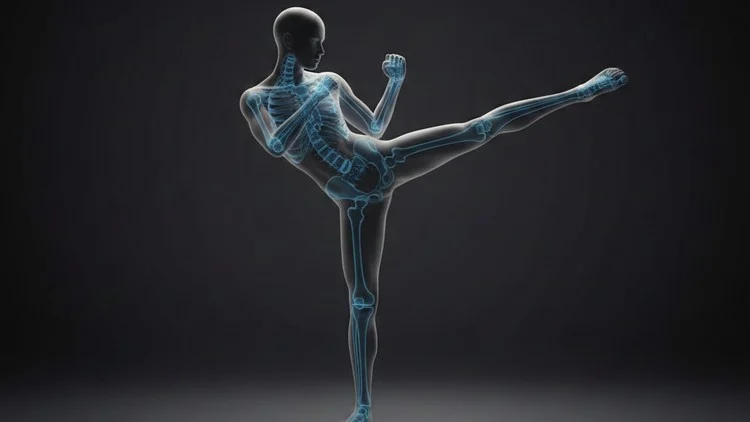
AI-powered movement analysis for sports, coaching, and rehabilitation.
⏱️ Length: 47 total minutes
👥 59 students
🔄 February 2026 update
Add-On Information:
Note➛ Make sure your 𝐔𝐝𝐞𝐦𝐲 cart has only this course you're going to enroll it now, Remove all other courses from the 𝐔𝐝𝐞𝐦𝐲 cart before Enrolling!
- Course Overview: The Fusion of Tradition and Tech: This introductory module explores the revolutionary intersection where the wisdom of a master coach (the Sensei) meets the empirical precision of data science (the Scientist). Participants will dive into how artificial intelligence transforms raw video footage into actionable kinetic insights, bridging the gap between subjective observation and objective reality in athletic training.
- Course Overview: Deciphering the Digital Skeleton: You will explore the foundational mechanics of pose estimation technology, learning how software identifies key anatomical landmarks to create a digital twin of an athlete. This process allows for the microscopic analysis of joint angles, center of gravity shifts, and postural alignment that the naked eye often misses.
- Course Overview: The 2026 Analytical Paradigm: Updated for the mid-2020s landscape, this course highlights the transition from expensive laboratory-grade motion capture to mobile-first AI solutions. We examine how ubiquitous smartphone technology has democratized high-level biomechanical analysis for local gyms, physical therapy clinics, and independent coaching businesses.
- Course Overview: Multidisciplinary Application Zones: The curriculum is designed to show the versatility of AI movement analysis across three primary pillars: elite sports performance, preventative orthopedic coaching, and the acceleration of post-surgical rehabilitation protocols.
- Course Overview: The Ethics of Bio-Data: As we step into the role of a Sensei Scientist, we address the critical importance of data privacy and the ethical considerations of tracking human movement patterns, ensuring that technology serves the athlete’s well-being above all else.
- Requirements / Prerequisites: Foundational Tech Literacy: While you do not need to be a software engineer, a basic comfort level with navigating digital platforms and mobile applications is essential for implementing the tools discussed in the 47-minute briefing.
- Requirements / Prerequisites: Basic Understanding of Anatomy: A cursory knowledge of human kinesiology—such as identifying major joints like the patella, glenohumeral joint, and vertebrae—will help you better understand the data points generated by AI skeletal mapping.
- Requirements / Prerequisites: Hardware Access: Students should have access to a modern smartphone or a laptop with a high-definition webcam to practice the video capture techniques essential for feeding data into the AI processing engines.
- Requirements / Prerequisites: The Growth Mindset: Because this course merges two historically separate fields (physical education and data science), a willingness to unlearn traditional coaching biases in favor of data-driven evidence is the most important prerequisite.
- Skills Covered / Tools Used: Computer Vision Frameworks: Gain exposure to the logic behind leading computer vision libraries like MediaPipe and OpenCV, understanding how they track motion in three-dimensional space using two-dimensional video inputs.
- Skills Covered / Tools Used: Quantitative Gait Analysis: Learn the specific skill of quantifying stride length, cadence, and ground contact time through automated video processing, providing a blueprint for running efficiency and injury risk assessment.
- Skills Covered / Tools Used: Kinematic Data Visualization: Master the ability to turn complex numerical outputs into intuitive visual charts and overlays that athletes can easily understand, making the “science” accessible to those without a technical background.
- Skills Covered / Tools Used: Predictive Modeling Basics: Explore how historical movement data can be used to predict potential injury “hotspots” before they manifest as physical pain, allowing for proactive intervention in training loads.
- Skills Covered / Tools Used: Virtual Coaching Interfaces: Learn to use cloud-based platforms that allow a Sensei Scientist to analyze an athlete’s movement remotely, breaking geographical barriers between the coach and the trainee.
- Benefits / Outcomes: Enhanced Coaching Authority: By integrating AI into your practice, you gain a massive competitive advantage, moving from “guessing” what is wrong with a movement to “knowing” exactly where the mechanical breakdown occurs.
- Benefits / Outcomes: Precision Rehabilitation: Physical therapists will learn how to provide patients with exact percentages of improvement in range of motion, fostering higher levels of patient motivation and clearer recovery timelines.
- Benefits / Outcomes: Optimized Athletic Efficiency: Athletes will discover how to shave milliseconds off their reaction times or add power to their strokes by identifying energy leaks in their kinetic chain through algorithmic feedback.
- Benefits / Outcomes: Reduced Injury Overhead: Organizations and teams can significantly lower the financial and physical costs of injuries by identifying high-risk movement patterns early in the pre-season or during intensive training blocks.
- Benefits / Outcomes: Scalable Expert Knowledge: The course empowers you to handle a larger roster of clients by automating the initial stages of movement screening, allowing you to focus your human expertise on high-level strategy and emotional support.
- Benefits / Outcomes: Future-Proofing Your Career: As the sports and health industries move toward a “Data-First” model, completing this introduction ensures you remain relevant in a market that increasingly demands technological proficiency alongside traditional coaching skills.
- PROS: Rapid Information Density: This course provides a high-impact overview in under 50 minutes, making it perfect for busy professionals who need to understand the “What” and “How” of AI without a long-term time commitment.
- PROS: Cutting-Edge Relevance: With the February 2026 update, the content reflects the most current advancements in generative motion modeling and real-time processing speeds.
- PROS: Low Entry Barrier: It simplifies complex mathematical concepts into digestible coaching philosophies, making the “Sensei Scientist” role attainable for anyone with a passion for human movement.
- PROS: Actionable Framework: Rather than just theorizing, the course provides a practical roadmap for integrating AI tools into your existing workflow immediately after completion.
- CONS: Scope Limitation: Due to its introductory nature and short duration, this course focuses more on the application and conceptual framework than the deep-level coding required to build your own custom AI models from scratch.
Learning Tracks: English,Health & Fitness,Martial Arts & Self Defense
Found It Free? Share It Fast!