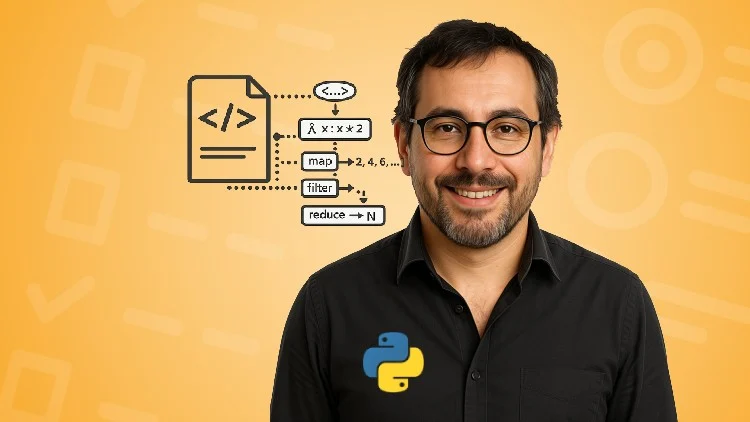
Python Lambda, Map, Filter & Reduce 120 unique high-quality test questions with detailed explanations!
👥 38 students
🔄 January 2026 update
Add-On Information:
Note➛ Make sure your 𝐔𝐝𝐞𝐦𝐲 cart has only this course you're going to enroll it now, Remove all other courses from the 𝐔𝐝𝐞𝐦𝐲 cart before Enrolling!
- Course Overview
- Foundational Transformation Strategy: This intensive practice-based course is meticulously engineered to bridge the gap between intermediate Python syntax and advanced functional programming paradigms. By focusing on the 2026 industry standards, the curriculum moves away from traditional imperative programming styles, instead guiding students toward a more declarative and concise approach to coding. The core philosophy of this course is that mastery comes through repetitive, diverse application, which is why the 120 unique questions are designed to cover every possible permutation of Lambda, Map, Filter, and Reduce.
- Modernized Curriculum for 2026: In an era where Python continues to evolve, staying current is vital. This January 2026 update ensures that all practice questions utilize the most efficient memory management techniques and follow the latest PEP 8 guidelines. The course content is specifically tailored to address how these functional tools interact with modern Python features, ensuring that learners are not practicing outdated methodologies but are instead preparing for the future of software development.
- High-Density Practice Environment: Unlike theoretical lectures, this course places you directly into a high-intensity testing environment. Each of the 120 questions serves as a mini-challenge, forcing you to think critically about data flow and transformation logic. The detailed explanations provided for every single question serve as a comprehensive breakdown of logic, helping to solidify your understanding of how anonymous functions can simplify complex operations.
- Student-Centric Evolution: With a growing community of 38 students as of the latest update, the course material has been refined based on common points of confusion and real-world feedback. This ensures that the explanations provided are not just technically accurate but are also pedagogical in nature, addressing the specific hurdles that developers face when transitioning to functional programming.
- Requirements / Prerequisites
- Core Python Competency: To get the most out of this practice set, participants should have a comfortable grasp of basic Python syntax, including how to define variables, manage basic arithmetic operations, and use conditional statements like if-elif-else.
- Familiarity with Iterables: A fundamental understanding of Python collections is necessary. You should know the basic differences between lists, tuples, sets, and dictionaries, as these are the primary data structures that you will be manipulating using functional tools.
- Conceptual Logic Skills: Since Map, Filter, and Reduce rely heavily on boolean logic and predicate functions, learners should be comfortable with logical operators (AND, OR, NOT) and the concept of returning truthy or falsy values from a function.
- Technical Setup: While the course is a collection of practice questions, it is highly recommended that you have a Python 3.x environment (such as VS Code, PyCharm, or an online Jupyter Notebook) available to manually test the logic provided in the detailed explanations and explore variations of the code.
- Skills Covered / Tools Used
- Advanced Lambda Expressions: You will gain the ability to write sophisticated, one-line anonymous functions that can handle multi-argument inputs and complex logic without the need for traditional def statements.
- Streamlined Data Transformation: Mastery of the Map function will allow you to apply logic across massive datasets instantly, converting data types or performing calculations on every element in an iterable with minimal code.
- Precision Data Filtering: You will learn to implement the Filter function to prune datasets based on specific criteria, mastering the use of predicate logic to keep your data processing pipelines clean and efficient.
- Cumulative Data Aggregation: The course dives deep into the Functools.reduce utility, teaching you how to perform rolling computations, such as finding the product of a list or flattening nested structures into a single value.
- Higher-Order Function Interoperability: A key skill covered is the nesting and chaining of functional tools. You will learn how to wrap a Filter inside a Map or feed the output of a Lambda into a Reduce operation for maximum efficiency.
- Performance Optimization: You will explore the tools used to benchmark functional code against traditional for-loops, learning when to use these utilities for speed and when to prioritize readability.
- Benefits / Outcomes
- Architectural Code Conciseness: One of the primary benefits is the dramatic reduction in code volume. You will learn to replace ten-line loops with single, elegant functional expressions, making your codebase more professional and easier to maintain.
- Superior Interview Performance: Technical interviews at top-tier tech companies often focus on functional logic to test a candidate’s depth of knowledge. Completing these 120 questions provides the competitive edge needed to solve coding challenges quickly and accurately.
- Enhanced Debugging Capabilities: By understanding the granular mechanics of Map and Filter, you will become faster at identifying logic errors in data processing scripts, as functional programming naturally isolates logic into pure, testable units.
- Preparation for Big Data Frameworks: Since tools like Apache Spark and Pandas rely heavily on the principles of mapping and reducing, this course serves as an essential stepping stone for anyone looking to enter the fields of Data Science or Data Engineering.
- Logical Mental Flexibility: Shifting between imperative and functional paradigms trains your brain to approach problems from multiple angles, increasing your overall computational thinking and problem-solving speed.
- PROS
- Extensive Variety: The 120 questions ensure that no two scenarios are identical, providing a broad spectrum of difficulty levels and real-world use cases.
- Exceptional Clarity: The detailed explanations are a major highlight, breaking down complex functional chains into digestible, easy-to-understand logical steps.
- Time-Efficient Learning: This course is designed for busy developers, offering a direct path to mastery without the fluff of long-winded video lectures.
- CONS
- Highly Specialized Focus: This course is purely dedicated to functional programming utilities and does not cover general Python topics, making it unsuitable for absolute beginners who have never written a line of code.
Learning Tracks: English,IT & Software,Other IT & Software
Found It Free? Share It Fast!