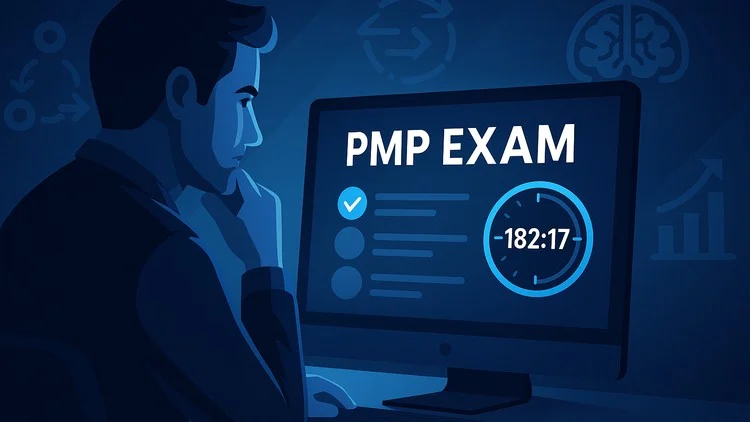
Master real PMP exam scenarios with 510 original case-based questions, 2 full-length mocks & detailed explanations.
👥 8 students
🔄 October 2025 update
Add-On Information:
Note➛ Make sure your 𝐔𝐝𝐞𝐦𝐲 cart has only this course you're going to enroll it now, Remove all other courses from the 𝐔𝐝𝐞𝐦𝐲 cart before Enrolling!
- Course Overview
- Provides a high-intensity, immersive simulation environment designed specifically to replicate the actual Pearson VUE testing interface and pressure.
- Features a robust bank of 510 original, situational questions that focus heavily on the “Project Manager’s Dilemma,” requiring analytical thinking over simple rote memorization.
- Full alignment with the latest Project Management Institute (PMI) standards, including the PMBOK Guide 7th Edition and the essential Agile Practice Guide.
- Includes two comprehensive, full-length mock examinations that mirror the 180-question structure and time constraints of the professional certification exam.
- Deep-dive pedagogical approach where every question is accompanied by an exhaustive rationale, explaining the logic for the correct choice and debunking common distractors.
- Structured curriculum that balances the three critical domains: People (managing teams and stakeholders), Process (technical aspects of project delivery), and Business Environment (organizational alignment and compliance).
- Updated for the October 2025 Examination Content Outline (ECO), incorporating recent global shifts toward digital transformation and remote team management within project frameworks.
- Designed to foster a “PMI Mindset,” teaching students how to interpret ambiguous scenarios through the lens of servant leadership and value-driven delivery.
- Requirements / Prerequisites
- A fundamental understanding of general project management lifecycle stages, including initiation, planning, execution, monitoring, and closing.
- Familiarity with the Project Management Institute’s (PMI) core terminology and the basic structure of the PMBOK Guide.
- While not strictly required, having completed a 35-hour formal PMP education course or holding a CAPM certification will significantly enhance the learning experience.
- Access to a stable internet connection and a modern web browser to utilize the interactive simulator features effectively.
- A dedicated commitment to rigorous study, as the scenario-based content requires high levels of concentration and critical reasoning.
- Basic knowledge of Agile ceremonies, artifacts, and roles is essential given the high percentage of Adaptive and Hybrid questions in the current exam format.
- Skills Covered / Tools Used
- Situational Analysis: Developing the ability to identify the “best,” “first,” or “next” action in complex, multi-variable project crises.
- Hybrid Methodology Application: Mastering the nuances of blending Predictive (Waterfall) and Adaptive (Agile) frameworks to suit diverse project needs.
- Conflict Resolution Models: Applying specific techniques like compromising, smoothing, or collaborating to solve team and stakeholder disputes.
- Earned Value Management (EVM): Interpreting performance indices such as CPI, SPI, CV, and SV to determine project health and forecast completion.
- Risk Strategy Management: Proficiency in identifying, categorizing, and responding to project threats and opportunities using qualitative and quantitative tools.
- Critical Path Analysis: Using network diagrams to identify project duration and applying schedule compression techniques like crashing and fast-tracking.
- Stakeholder Engagement Matrix: Utilizing tools to assess power, interest, and influence to maintain organizational support throughout the project lifecycle.
- Compliance and Governance: Ensuring project deliverables meet legal, safety, and organizational quality standards in various business environments.
- Benefits / Outcomes
- Significant reduction in exam-day anxiety by acclimatizing the student to the rigorous pacing and linguistic style of the actual PMP examination.
- Enhanced decision-making capabilities that allow for the distinction between technically “correct” answers and the “best” professional response.
- Granular identification of knowledge gaps through detailed performance tracking, allowing students to focus their revision on specific weak areas within the ECO domains.
- Improved reading comprehension and speed, which is vital for processing the lengthy, wordy case studies typically found in the modern exam.
- Creation of a sustainable study rhythm that transforms theoretical knowledge into practical, application-based expertise.
- Acquisition of a globally recognized project management vocabulary that facilitates better communication with executive leadership and cross-functional teams.
- Long-term retention of project management principles through the “learning by failure” method provided by the simulator’s corrective feedback loops.
- Attainment of the professional confidence required to lead high-stakes projects in any industry, from construction and IT to healthcare and finance.
- PROS
- Extremely realistic difficulty levels that are frequently cited as being more challenging than the actual exam, ensuring students are over-prepared.
- High-quality, original content that avoids the outdated and repetitive questions found in many free or legacy practice banks.
- The 2025 update ensures that all scenario questions reflect current industry trends, such as distributed teams and emotional intelligence in leadership.
- The detailed rationales act as a “mini-course” themselves, providing a refresher on theory without the need to consult multiple textbooks.
- Flexible, on-demand access allows for targeted practice sessions, making it ideal for busy professionals balancing work and certification goals.
- CONS
- The simulator is exceptionally intensive and mentally demanding, which may prove overwhelming for students who are in the very early stages of their PMP journey and lack a solid grasp of foundational concepts.
Learning Tracks: English,Business,Project Management
Found It Free? Share It Fast!