“Master OOP in Python: 100 Coding Challenges to Ace Exams & Real-World Applications
👥 1 students
🔄 October 2025 update
Add-On Information:
Note➛ Make sure your 𝐔𝐝𝐞𝐦𝐲 cart has only this course you're going to enroll it now, Remove all other courses from the 𝐔𝐝𝐞𝐦𝐲 cart before Enrolling!
-
Course Overview
- This specialized course, ‘OOP Principles Exam Practice Coding Challenges’, is meticulously designed to solidify your understanding and application of Object-Oriented Programming (OOP) principles using Python. It moves beyond theoretical concepts by immersing you in a rigorous practical environment.
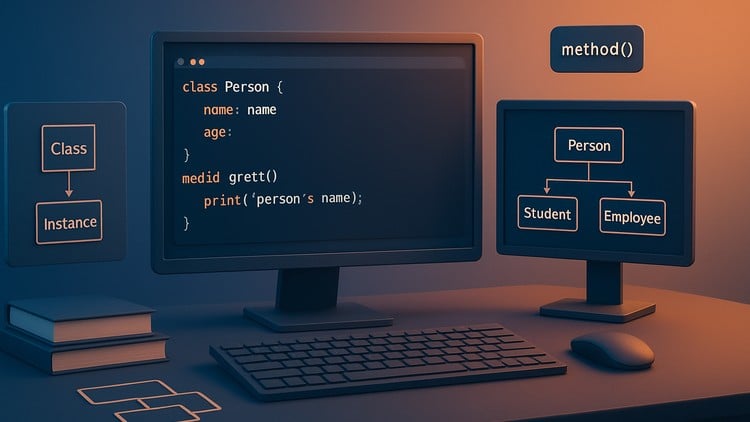
- Drawing from its caption, “Master OOP in Python: 100 Coding Challenges to Ace Exams & Real-World Applications,” this course features an extensive collection of 100 unique coding challenges, each crafted to test and enhance your grasp of core OOP paradigms.
- The primary objective is to build a robust foundation that not only prepares you for challenging technical exams and certifications but also equips you with the practical skills essential for developing scalable, maintainable, and efficient applications in real-world scenarios.
- You will engage with problems ranging from fundamental class and object creation to intricate inheritance hierarchies, polymorphism, and abstraction, ensuring a comprehensive learning curve. The curriculum is structured to progressively increase in difficulty, fostering continuous skill development.
-
Requirements / Prerequisites
- Foundational Python Knowledge: A basic understanding of Python syntax, including variables, data types, control flow (loops, conditionals), and functions, is essential. This course builds upon these fundamentals.
- Basic Programming Logic: Familiarity with general programming concepts and problem-solving approaches is highly recommended. While OOP concepts will be taught from the ground up, basic algorithmic thinking will be beneficial.
- Development Environment: Access to a computer with a Python interpreter (version 3.x recommended) installed and a preferred code editor or Integrated Development Environment (IDE) like VS Code, PyCharm, or Jupyter Notebook.
- Commitment to Practice: The course is heavily challenge-driven. A willingness to actively engage with the 100 coding problems, debug solutions, and iteratively improve your code is crucial for success.
-
Skills Covered / Tools Used
- Core OOP Principles in Python: Master the implementation of Encapsulation (data hiding, getters/setters), Inheritance (single, multiple, multilevel, hierarchical), Polymorphism (method overriding, method overloading through design patterns), and Abstraction (abstract classes and methods).
- Class and Object Design: Develop proficiency in designing well-structured classes, defining attributes and methods, understanding constructor methods (`__init__`), and creating instances of objects.
- Special Methods (Dunder Methods): Learn to effectively use Python’s magic methods (e.g., `__str__`, `__repr__`, `__eq__`, `__len__`) to enhance class behavior and create more intuitive objects.
- Error Handling and Debugging: Improve your ability to identify, understand, and resolve logical and syntax errors within your OOP code. Practice implementing robust error handling mechanisms.
- Python Programming Language: Deepen your practical command over Python, specifically in an object-oriented context, leveraging its built-in features and best practices for OOP development.
- Modular Code Development: Understand how to break down complex problems into smaller, manageable, and reusable components using classes and objects, fostering clean and maintainable codebases.
- Test-Driven Development (Implied): While not explicitly a TDD course, the challenge-based format inherently encourages a “solve and test” iterative development cycle, similar to TDD principles.
-
Benefits / Outcomes
- Exam Readiness: Significantly boost your performance in university exams, certification tests, and technical assessments that feature a strong emphasis on Object-Oriented Programming concepts and their practical application.
- Enhanced Problem-Solving: Cultivate a systematic approach to solving complex programming challenges by applying OOP principles, leading to more elegant and efficient solutions.
- Robust Code Creation: Learn to write Python code that is not only functional but also adheres to OOP best practices, resulting in code that is easier to read, debug, maintain, and extend.
- Real-World Application Confidence: Gain the confidence to tackle larger, more intricate software projects by effectively utilizing OOP to model real-world entities and their interactions.
- Portfolio Enhancement: The completion of 100 diverse coding challenges provides substantial practical experience that can be showcased in your personal coding portfolio, demonstrating tangible skills to potential employers.
- Interview Preparation: Develop a strong foundational understanding and practical experience that will enable you to confidently answer OOP-related questions and solve coding problems during technical interviews.
-
PROS
- Extensive Hands-on Practice: With 100 unique coding challenges, the course offers unparalleled opportunities to apply OOP concepts repeatedly, cementing understanding through active learning rather than passive consumption.
- Direct Exam Alignment: The challenges are specifically designed to mirror the types of problems encountered in technical exams and coding assessments, making it an excellent resource for exam preparation.
- Bridging Theory to Practice: This course excels at taking abstract OOP theories and translating them into concrete, solvable programming problems, solidifying conceptual knowledge with practical implementation.
- Focus on Python: Leveraging Python, a widely used and accessible language, makes the learning curve smoother while ensuring the acquired skills are highly relevant in the current job market.
- Develops Deeper Understanding: Unlike courses that just skim the surface, the sheer volume and variety of challenges compel learners to engage deeply with each OOP principle, fostering a truly profound understanding.
- Versatile Skill Set: The practical OOP skills gained are highly transferable, benefiting aspiring software developers, data scientists, and anyone looking to build complex, well-structured Python applications.
-
CONS
- Significant Time Commitment: Mastering 100 coding challenges effectively requires a substantial investment of time and consistent effort, which may be challenging for individuals with very limited schedules.
Learning Tracks: English,IT & Software,IT Certifications
Found It Free? Share It Fast!