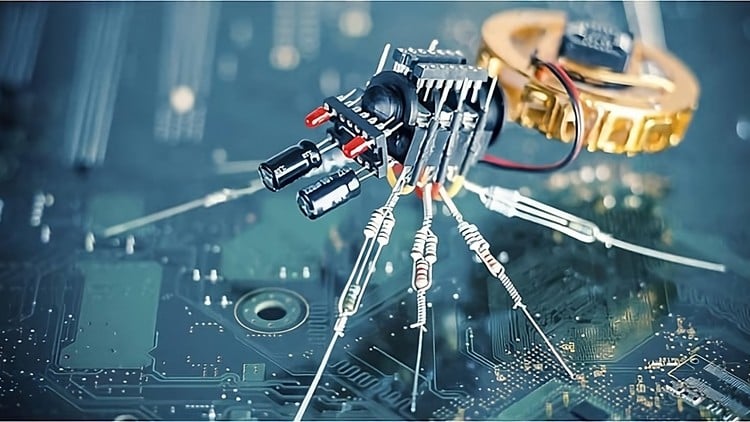
MEMS: Fundamentals, Scaling Laws, and Microscale Physics
⏱️ Length: 3.7 total hours
👥 76 students
Add-On Information:
Note➛ Make sure your 𝐔𝐝𝐞𝐦𝐲 cart has only this course you're going to enroll it now, Remove all other courses from the 𝐔𝐝𝐞𝐦𝐲 cart before Enrolling!
-
Course Overview
- Explore the transformative impact of Microelectromechanical Systems (MEMS) on diverse technological landscapes, from consumer electronics to medical devices and industrial automation.
- Gain a comprehensive understanding of the conceptual framework underpinning MEMS technology, bridging macroscopic engineering and atomic-level material science.
- Investigate the unique challenges and innovative solutions involved in designing devices that seamlessly integrate electrical and mechanical functionalities at the micro-scale.
- Delve into the fundamental principles that govern system behavior in the micro-domain, where traditional physics often yields to dominant surface effects and novel phenomena.
- Appreciate MEMS as a true interdisciplinary frontier, demanding a synthesis of knowledge from electrical engineering, mechanical engineering, materials science, and applied physics.
- Uncover how miniaturization enables unprecedented performance, efficiency, and integration, paving the way for ubiquitous smart sensors and sophisticated actuators.
- Examine the historical trajectory and future trends of MEMS technology, recognizing its pivotal role in the ongoing revolution of sensing, actuation, and data processing.
- Understand the strategic importance of MEMS as an enabling technology enhancing the functionality and reducing the size of modern electronic and biological systems.
-
Requirements / Prerequisites
- Foundational Calculus and Differential Equations: A solid working knowledge of advanced calculus, including ordinary and partial differential equations, is essential for modeling microscale phenomena.
- Classical Physics Background: Proficiency in classical mechanics (statics, dynamics, vibrations), electromagnetism (fields, circuits), and basic thermodynamics will provide necessary contextual understanding.
- Basic Circuit Theory: Familiarity with fundamental circuit analysis, including Ohm’s Law, Kirchhoff’s Laws, and basic component behavior, is crucial for understanding integrated electronics.
- Introductory Materials Science: An understanding of material properties, crystalline structures, and basic semiconductor physics will be beneficial for grasping silicon’s unique characteristics.
- Problem-Solving Acumen: The ability to approach complex, multi-domain engineering problems systematically and apply analytical methods is highly recommended.
- Conceptual Understanding of Engineering Systems: Prior exposure to general engineering design principles and system-level thinking aids in comprehending MEMS device integration.
-
Skills Covered / Tools Used
- Conceptual Device Design: Develop an intuitive grasp of translating real-world problems into functional micro-device architectures, considering fundamental physical constraints.
- Analytical Model Development: Learn to construct simplified mathematical models that capture the essential behavior of micro-mechanical elements and their electrical interfaces.
- Multi-Domain Physics Interpretation: Gain expertise in identifying and interpreting the interplay between electrical, mechanical, thermal, and fluidic domains within a single micro-system.
- System-Level Integration Principles: Understand critical considerations for integrating micro-mechanical structures with control electronics, packaging, and external environments.
- Critical Evaluation of Microfabrication Constraints: Develop an awareness of how manufacturing processes influence device design choices and performance limits.
- Basic Device Characterization Concepts: Explore conceptual methods for testing and validating MEMS device performance, including force-displacement, frequency response, and electrical measurements.
- Introduction to Simulation Philosophy: Acquire a conceptual understanding of how computational tools (e.g., FEM solvers) are used to simulate complex MEMS behavior.
- Innovation in Miniaturization: Cultivate a mindset geared towards novel applications and creative solutions made possible by scaling down engineering systems.
-
Benefits / Outcomes
- Deep Intuition for Microscale Phenomena: Develop a profound understanding and practical intuition for how physics fundamentally changes at the micro- and nano-scales.
- Analytical Foundation for Advanced MEMS: Establish a robust theoretical and practical base for pursuing advanced studies, research, or development in specialized MEMS fields.
- Enhanced Interdisciplinary Problem-Solving: Sharpen your ability to tackle engineering challenges spanning multiple disciplines, fostering a holistic and integrated approach.
- Preparation for Emerging Technologies: Position yourself at the forefront of innovation, ready to contribute to the design and implementation of next-generation smart sensors and integrated systems.
- Critical Assessment of Existing Devices: Gain the knowledge to critically evaluate the design, functionality, and limitations of commercial and research-grade MEMS devices.
- Career Versatility in High-Tech Sectors: Open doors to diverse career paths in semiconductor, medical technology, automotive, aerospace, consumer electronics, and academic research.
- Contribution to Miniaturization Trends: Empower yourself to actively participate in the ongoing technological drive towards smaller, more efficient, and integrated solutions.
- Appreciation for Design Trade-offs: Understand the inherent compromises and optimizations required in MEMS design, balancing performance, cost, reliability, and manufacturing feasibility.
-
PROS
- Highly Relevant and Forward-Looking Field: This course delves into a rapidly expanding area of engineering central to current and future technological advancements.
- Interdisciplinary Knowledge Synthesis: Offers a unique opportunity to integrate concepts from multiple engineering and scientific domains, enriching your overall technical perspective.
- Strong Foundational Learning: Provides a comprehensive introduction to MEMS core principles, setting solid groundwork for further specialization or advanced research.
- Direct Link to Real-World Applications: Concepts taught are directly applicable to the design and understanding of countless devices used in everyday life and industrial settings.
- Fosters Innovative Thinking: Encourages students to think creatively about how miniaturization can solve complex problems and create new product categories.
-
CONS
- Demanding Multidisciplinary Nature: The requirement to synthesize knowledge from various engineering and physics fields can present a significant intellectual challenge and steep learning curve.
Learning Tracks: English,Teaching & Academics,Engineering
Found It Free? Share It Fast!