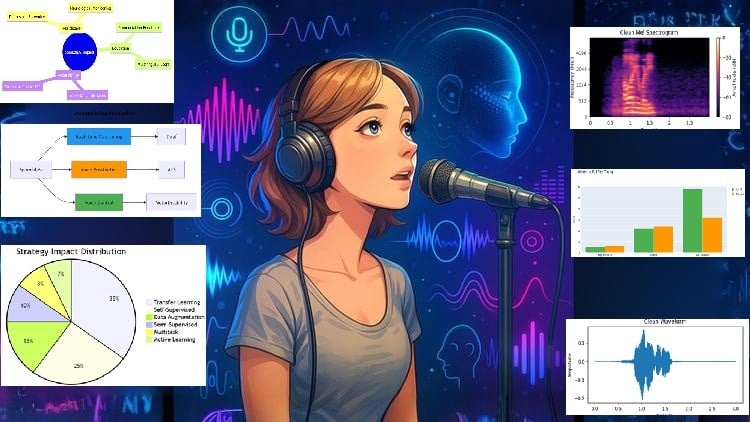
Master cutting-edge SpeechLMs and build next-generation voice AI applications with end-to-end speech capabilities
⏱️ Length: 19.5 total hours
⭐ 4.90/5 rating
👥 4,977 students
🔄 October 2025 update
Add-On Information:
Note➛ Make sure your 𝐔𝐝𝐞𝐦𝐲 cart has only this course you're going to enroll it now, Remove all other courses from the 𝐔𝐝𝐞𝐦𝐲 cart before Enrolling!
- Course Overview
- Embark on a transformative journey into the dynamic field of Voice Artificial Intelligence, exploring the foundational theories and cutting-edge practical applications that define modern human-computer interaction.
- Uncover the intricate pipeline from raw acoustic signals to sophisticated speech understanding and generation, providing a holistic perspective on the entire Voice AI ecosystem.
- Delve deep into the core mechanisms behind automatic speech recognition (ASR), understanding how spoken language is accurately transcribed into text for diverse applications like voice assistants and transcription services.
- Explore the nuanced realm of Emotion AI, learning to build intelligent systems capable of detecting and interpreting human emotional states from vocal cues, enabling more empathetic and responsive AI interactions.
- Master the advanced techniques of voice cloning, empowering you to synthesize new speech in a target voice, opening doors for personalized content creation, digital voice avatars, and accessibility solutions.
- Gain profound insights into the architectural evolution of Speech Language Models (SpeechLMs), understanding their historical progression and the paradigm shift brought about by modern deep learning architectures.
- Understand the critical role of robust data curation, augmentation strategies, and ethical considerations in developing fair, unbiased, and performant Voice AI systems, moving beyond mere technical implementation.
- Position yourself at the forefront of a rapidly accelerating technological domain, equipped with the knowledge and practical skills to innovate and contribute significantly to the next generation of voice-powered experiences.
- Requirements / Prerequisites
- A solid understanding of fundamental programming concepts, with demonstrated proficiency in Python being highly recommended.
- Familiarity with basic machine learning principles, including concepts like supervised learning, neural networks, and the general model training and validation workflow.
- An eagerness to engage with mathematical concepts related to signal processing, probability, and linear algebra, which form the analytical bedrock of audio analysis.
- Comfort navigating command-line interfaces and basic familiarity with version control systems, particularly Git.
- Access to a computer with a stable internet connection capable of running development environments and handling potentially intensive computational tasks (though cloud resources may be utilized).
- While not strictly mandatory, prior exposure to deep learning frameworks such as PyTorch or TensorFlow will significantly aid in a quicker grasp of advanced topics.
- Skills Covered / Tools Used
- Advanced Python Programming: Apply sophisticated Python libraries for efficient data manipulation, scientific computing, and constructing complex deep learning models specific to speech.
- Deep Learning Frameworks: Gain extensive hands-on experience with industry-standard frameworks like PyTorch or TensorFlow for building, training, and deploying advanced SpeechLMs.
- Audio Processing Libraries: Utilize specialized Python libraries such as Librosa, SciPy, or Pydub for low-level audio manipulation, feature extraction, filtering, and comprehensive acoustic analysis.
- Data Pipelining and Augmentation: Construct efficient data loaders and processing pipelines optimized for large-scale audio datasets, incorporating techniques like batching, parallel processing, and acoustic augmentation.
- Generative Models for Speech: Implement and experiment with various generative adversarial networks (GANs), variational autoencoders (VAEs), and diffusion models as they apply to sophisticated speech synthesis and voice conversion.
- Cloud AI Services Integration: Explore integrating pre-trained cloud-based Voice AI APIs (e.g., Google Cloud Speech-to-Text, AWS Polly) with custom models for robust hybrid solutions.
- Fine-tuning and Transfer Learning: Master the critical techniques of fine-tuning large pre-trained SpeechLMs for specific domain tasks and datasets, optimizing performance with limited new data.
- API Development for Voice AI: Learn to encapsulate your trained Voice AI models into scalable and accessible APIs, making them consumable by web applications, mobile apps, or other services.
- Containerization with Docker: Understand the fundamentals of packaging Voice AI applications using Docker for consistent, reproducible, and portable deployment across diverse environments.
- Responsible AI Practices: Develop a keen awareness of bias, fairness, privacy, and security implications specific to voice data, integrating ethical considerations into every stage of development and deployment.
- Experiment Tracking and MLOps Basics: Gain experience with tools and methodologies for logging experiments, tracking metrics, managing different model versions, and streamlining the machine learning lifecycle.
- Benefits / Outcomes
- Become a Voice AI Innovator: Equip yourself to conceptualize, design, and implement novel voice-powered applications that push the boundaries of current human-computer interaction paradigms.
- Accelerated Career Advancement: Position yourself as a highly sought-after professional in the burgeoning field of Voice AI, opening doors to lucrative roles such as Machine Learning Engineer, Speech AI Developer, or Data Scientist specializing in audio.
- Build Production-Ready Systems: Move beyond theoretical understanding to practical application, capable of developing robust, scalable, and efficient Voice AI solutions that perform in real-world scenarios.
- Empowered Personal Project Development: Gain the confidence and comprehensive skills to embark on ambitious personal projects, ranging from custom voice assistants to unique audio content generation tools.
- Deep Technical Acumen: Cultivate a profound understanding of the underlying algorithms, architectures, and data science principles that govern modern speech technology, from signal processing to deep neural networks.
- Contribution to Accessibility: Develop the ability to create impactful voice technologies that significantly enhance accessibility for diverse user groups, fostering more inclusive and equitable digital experiences.
- Enhanced Problem-Solving Mastery: Sharpen your analytical and problem-solving skills by tackling complex challenges inherent in speech data analysis, model optimization, and ethical technology deployment.
- Future-Proof Your Skillset: Invest in expertise that is at the cutting edge of AI innovation, ensuring long-term relevance and adaptability in a technology landscape increasingly dominated by intelligent voice interfaces.
- PROS
- High-Demand Skillset: Voice AI expertise is one of the most rapidly growing and valuable assets in the modern tech industry.
- Comprehensive Coverage: Spans the entire spectrum of Voice AI, from fundamental ASR to advanced generative models like voice cloning.
- Practical, Hands-on Focus: Emphasizes building real-world applications and working directly with diverse speech datasets.
- Cutting-Edge Curriculum: Keeps pace with the latest advancements in Speech Language Models and deep learning architectures.
- Industry-Relevant Tools: Focuses on frameworks and libraries widely adopted in professional Voice AI development.
- Strong Community Potential: Provides a pathway to engage with a vibrant and growing community, offering ample opportunities for collaboration and innovation.
- Tangible Portfolio Projects: Enables the creation of concrete projects suitable for showcasing your abilities to potential employers.
- CONS
- Requires a significant commitment of time, dedication, and effort to fully master the complex theoretical concepts and practical implementations.
Learning Tracks: English,IT & Software,Other IT & Software
Found It Free? Share It Fast!