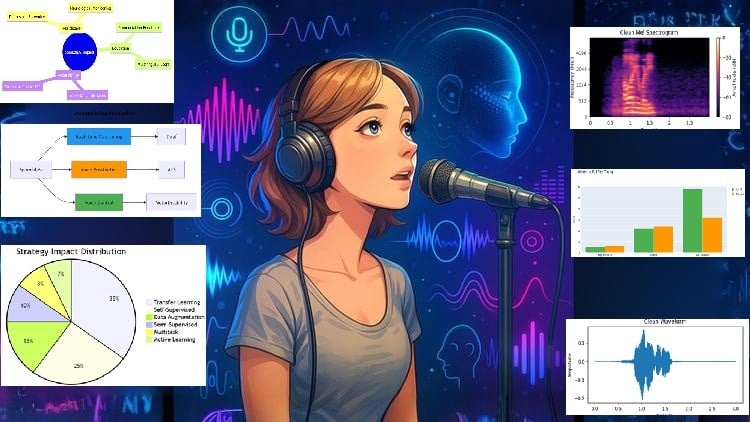
Master cutting-edge SpeechLMs and build next-generation voice AI applications with end-to-end speech capabilities
⏱️ Length: 19.5 total hours
⭐ 4.87/5 rating
👥 3,346 students
🔄 October 2025 update
Add-On Information:
Note➛ Make sure your 𝐔𝐝𝐞𝐦𝐲 cart has only this course you're going to enroll it now, Remove all other courses from the 𝐔𝐝𝐞𝐦𝐲 cart before Enrolling!
-
Course Overview
- Embark on an immersive journey into Voice AI, from foundational signal processing to advanced generative models, spanning all speech technology.
- Gain deep insights into the architecture and function of cutting-edge Speech Large Language Models (SpeechLMs) powering intelligent agents.
- Explore the evolution of Automated Speech Recognition (ASR), understanding real-time transcription and contextual interpretation beyond basic transcription.
- Delve into the nuances of Emotion AI, learning how algorithms interpret and synthesize human emotions from vocal cues for empathetic interactions.
- Master the transformative techniques of voice cloning, enabling replication of unique vocal identities for personalized AI and innovative content.
- Position yourself as a leader in a rapidly expanding field, equipped to build intuitive, intelligent, and deeply integrated voice-enabled applications.
- Understand critical aspects of data curation, model interpretability, and responsible deployment to build ethical and fair Voice AI systems.
-
Requirements / Prerequisites
- Strong Python programming skills are essential, as the course emphasizes practical coding and implementation.
- Familiarity with fundamental machine learning concepts, including model training, evaluation, and basic neural networks.
- Prior exposure to deep learning frameworks like PyTorch or TensorFlow is beneficial; concepts will be covered.
- An eager mind for complex mathematical and algorithmic concepts underpinning signal processing and natural language processing.
- Access to a robust development environment, ideally with GPU acceleration, for efficient deep learning task execution.
-
Skills Covered / Tools Used
- Advanced Audio Processing: Robust noise reduction, speaker diarization, and sophisticated audio normalization.
- Next-Gen SpeechLM Architectures: Implement and fine-tune advanced Transformer models like Conformer, Wav2Vec 2.0, and HuBERT for speech.
- End-to-End Real-time ASR: Construct low-latency ASR pipelines processing streaming audio and deploying to platforms.
- Prosodic Feature Engineering: Extract and manipulate prosodic elements (pitch, rhythm, intonation) vital for natural speech synthesis and emotion detection.
- Multimodal Emotion AI: Integrate vocal emotion recognition with other data types for holistic sentiment understanding.
- Ethical Voice Synthesis & Cloning: Understand technical and societal implications of synthetic voices, focusing on ethical use.
- Voice AI Deployment Strategies: Explore methods for deploying SpeechLMs to cloud (AWS, GCP) or edge devices, optimizing performance.
- Speech Model Benchmarking: Master evaluating complex SpeechLMs using advanced metrics and interpretability techniques.
- Advanced Data Augmentation: Implement sophisticated augmentation for speech data to improve model robustness across diverse styles.
- Python Deep Learning Ecosystem: Proficiency with Librosa, PyTorch/TensorFlow, Hugging Face Transformers, and specialized audio and DL tools.
-
Benefits / Outcomes
- Become a Full-Stack Voice AI Developer: Gain expertise to design, build, train, and deploy sophisticated voice applications from concept to deployment.
- Innovate in Conversational AI: Drive the development of intelligent agents and virtual assistants with human-like understanding.
- Unlock Creative Content Production: Leverage voice cloning and synthesis for personalized audio experiences, professional dubbing and vocal branding.
- Pioneer Empathetic AI: Develop systems recognizing and responding to human emotions, fostering natural, helpful AI in diverse sectors.
- Master Ethical AI Practices: Cultivate strong understanding of responsible AI development, ensuring privacy protection and preventing misuse.
- Build an Expert Portfolio: Showcase advanced projects in ASR, emotion recognition, and voice cloning, demonstrating high-demand skills.
- Gain a Competitive AI Edge: Differentiate yourself with specialized end-to-end SpeechLM development skills, becoming a valuable asset in cutting-edge AI.
- Anticipate Future AI Trends: Prepare for advancements in generative AI for speech, multimodal AI, and evolving HCI.
- Contribute to Open-Source: Develop skills to actively engage with and contribute to leading open-source projects in speech tech.
- Bridge Theory to Practice: Gain both theoretical foundation and practical application knowledge (‘why’ and ‘how’) of Voice AI.
-
PROS
- Comprehensive Curriculum: Offers a complete learning path from foundational ASR to advanced generative models like voice cloning and emotion AI.
- High Industry Relevance: Focuses on in-demand skills and real-world applications, directly aligning with current and future AI industry needs.
- Practical, Hands-on Learning: Emphasizes building projects, ensuring learners acquire valuable practical experience alongside theoretical understanding.
- Up-to-date Content: The October 2025 update ensures the curriculum remains current with the latest advancements in speech technology and research.
-
CONS
- The extensive breadth and depth of topics may require a significant time commitment, potentially challenging for absolute beginners in AI.
Learning Tracks: English,IT & Software,Other IT & Software
Found It Free? Share It Fast!