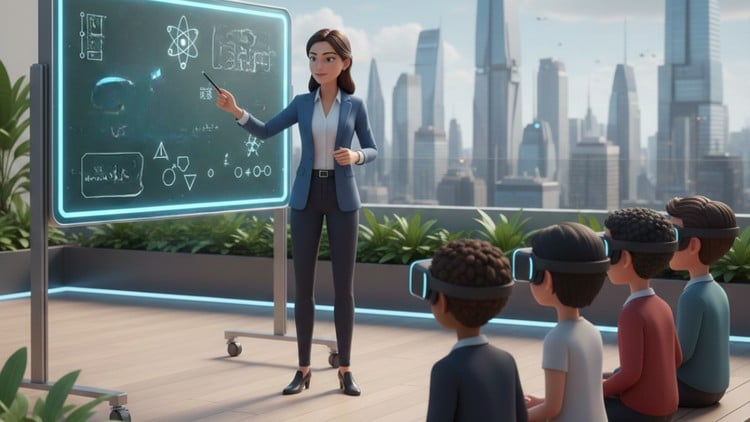
Learn 3D modeling, cinematic lighting, and digital environment design to build immersive, high-tech educational scenes.
👥 151 students
Add-On Information:
Note➛ Make sure your 𝐔𝐝𝐞𝐦𝐲 cart has only this course you're going to enroll it now, Remove all other courses from the 𝐔𝐝𝐞𝐦𝐲 cart before Enrolling!
- Conceptualizing the Futuristic Educator Archetype: This course provides a comprehensive exploration of the creative process required to envision the next generation of digital mentors, blending classical pedagogical traits with cutting-edge science fiction aesthetics to create characters that feel both authoritative and technologically advanced.
- Narrative-Driven Character Construction: Beyond the technicalities of modeling, students will learn to embed narrative depth into their designs, ensuring that every cybernetic enhancement, holographic tool, or futuristic garment serves a specific purpose in the educator’s backstory and teaching methodology within a high-tech society.
- Comprehensive Environment Synergy: We delve into the critical relationship between a character and their digital habitat, teaching you how to build immersive 3D classrooms that respond dynamically to the character’s presence through interactive lighting and architectural elements that reinforce the futuristic theme.
- Psychology of Digital Avatars in Learning: Gain insights into the visual psychology behind character design, learning how to use shapes, colors, and silhouettes to evoke trust, curiosity, and engagement in a virtual learning environment, which is essential for creating effective educational avatars.
- Technical Foundation in 3D Space: Prospective learners should possess a functional understanding of 3D coordinate systems and have a basic level of comfort navigating a digital 3D viewport, ensuring a smooth transition into the advanced sculpting and modeling techniques covered throughout the curriculum.
- High-Performance Hardware Requirements: To successfully handle the demands of cinematic lighting and high-poly character sculpting, students are encouraged to use a workstation equipped with a dedicated graphics card and sufficient RAM to facilitate real-time rendering and complex texture baking without hardware bottlenecks.
- Software Proficiency and Readiness: The course assumes access to industry-standard Digital Content Creation (DCC) tools such as Blender, ZBrush, or Maya, and while specific workflows are demonstrated, the core principles taught are designed to be adaptable across various professional 3D software packages.
- Advanced Hard-Surface Modeling for Cybernetics: Master the precision required for designing robotic components and mechanical armor, focusing on clean topology and beveling techniques that allow for realistic reflections and believable mechanical movements in a futuristic setting.
- Organic Sculpting for Humanoid Realism: Learn the intricacies of digital sculpting to create realistic facial features and skin textures for your educators, ensuring that the human element of the character is preserved and enhanced by their technological integrations.
- Procedural and PBR Texturing Workflows: Utilize Physically Based Rendering (PBR) techniques to craft complex materials such as brushed titanium, translucent smart-glass, and synthetic fabrics, providing your characters and environments with a level of tactile realism that meets modern industry standards.
- Cinematic Lighting Orchestration: Explore the art of volumetric lighting and global illumination to create atmosphere and depth within your scenes, using light to highlight the intricate details of your character design and set the emotional tone of the educational environment.
- Holographic UI and HUD Design: Discover how to integrate 3D user interfaces and data visualizations directly into your scenes, simulating the types of information displays a futuristic educator would use to communicate complex concepts to their digital students.
- Portfolio-Ready Masterpiece Creation: Upon completion of the course, you will have developed a high-fidelity, polished 3D scene that serves as a significant addition to your professional portfolio, demonstrating your ability to execute a complex vision from initial concept to final render.
- Versatile Industry-Standard Skills: The design methodologies and technical workflows mastered here are highly transferable, equipping you for roles in game development, film production, and the rapidly expanding field of virtual reality education and corporate training.
- Workflow Optimization for High-Poly Assets: Learn the essential balance between visual complexity and scene performance, mastering retopology and texture optimization techniques that allow your high-detail character designs to be used efficiently in real-time engines.
- Deepened Visual Storytelling Capabilities: You will graduate with a heightened ability to use color theory, composition, and environmental cues to tell a story without words, a vital skill for any professional artist working in character-driven media or conceptual design.
- PROS: Specialized Niche Focus: This course offers a unique focus on the intersection of educational technology and high-end 3D art, providing students with a competitive edge in a growing market that requires sophisticated digital avatars for virtual instruction.
- PROS: Comprehensive Technical Depth: The curriculum moves beyond basic modeling to cover advanced topics like cinematic composition and PBR texturing, ensuring that the final output looks professional and production-ready rather than amateur.
- CONS: High Complexity Learning Curve: The advanced nature of the lighting and sculpting modules may present a significant challenge for absolute beginners, requiring a dedicated commitment to practice and experimentation to master the multi-faceted 3D workflow.
Learning Tracks: English,IT & Software,Other IT & Software
Found It Free? Share It Fast!