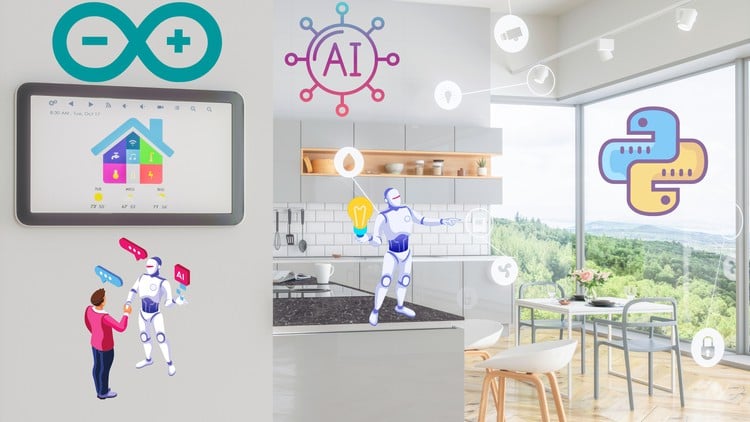
Home Automation Using J.A.R.V.I.S AI Assistant With Arduino UNO Board
⏱️ Length: 1.5 total hours
⭐ 4.26/5 rating
👥 22,895 students
🔄 October 2021 update
Add-On Information:
Note➛ Make sure your 𝐔𝐝𝐞𝐦𝐲 cart has only this course you're going to enroll it now, Remove all other courses from the 𝐔𝐝𝐞𝐦𝐲 cart before Enrolling!
-
Course Overview
- Build your own J.A.R.V.I.S-like AI assistant specifically for home automation.
- Integrate intelligent software with tangible hardware using the versatile Arduino UNO board.
- Transform ordinary household devices into smart, interconnected components within your living space.
- Explore practical AI applications for enhancing daily home convenience and efficiency.
- Gain hands-on experience in building a responsive, interactive smart home system from the ground up.
- Effectively bridge the gap between software development and hardware engineering principles.
- Learn to create a voice-activated system capable of automating various home functions.
- Discover methods to personalize AI responses for a unique and engaging user experience.
- Understand the core concepts involved in setting up an intelligent home environment.
- Fast-track your entry into the exciting fields of IoT and smart technology with a tangible project.
- This course adopts a project-based approach for highly effective and real-world learning.
- Ideal for beginners eager to explore DIY tech and smart home automation.
- Get a foundational understanding of how AI can interact with physical systems.
- Develop a basic framework for future, more complex automation projects.
-
Requirements / Prerequisites
- Basic computer literacy, including comfort with operating system navigation and software installation.
- A desktop or laptop computer (Windows, macOS, or Linux) for programming and Arduino connection.
- An Arduino UNO board and a compatible USB cable are essential hardware components.
- A basic electronics starter kit, including a breadboard, jumper wires, resistors, and LEDs, is highly recommended.
- A stable internet connection for downloading necessary software, libraries, and online resources.
- Genuine enthusiasm for DIY electronics and curiosity about smart home innovation is key.
- Familiarity with basic electrical concepts (e.g., voltage, current) is beneficial but not mandatory.
- No prior programming experience is strictly required, though logical thinking skills are helpful.
- A willingness to experiment, troubleshoot, and learn from hardware-software interactions.
- Access to a relatively quiet environment for effective voice command testing may be useful.
- Patience and persistence for debugging electronic circuits and code.
- Ability to follow step-by-step instructions for hardware assembly and software configuration.
-
Skills Covered / Tools Used
- Arduino UNO programming for precise microcontroller control and logic execution.
- Designing fundamental electronic circuits for various home automation tasks.
- Developing the core logical structure for a personalized artificial intelligence assistant.
- Interfacing various sensors (e.g., temperature, light) to accurately collect environmental data.
- Controlling actuators (like relays) to automate home appliances such as lights and fans.
- Basic Python programming for AI scripting, data processing, and integration with hardware.
- Efficiently troubleshooting hardware-software interactions to ensure smooth operation.
- Gaining proficiency with the Arduino IDE for code development, compilation, and uploading.
- Understanding the principles of voice command processing, including speech-to-text conversion.
- Implementing basic text-to-speech functionalities for AI verbal responses and feedback.
- Basic system integration strategies for connecting different smart devices and modules.
- Effective management of input and output signals on an Arduino board for various actions.
- Practical application of Internet of Things (IoT) concepts in a real-world home setting.
- Project conceptualization and execution, taking an idea from concept to a functional prototype.
- Learning to interpret simple circuit diagrams for hardware assembly.
- Utilizing common development tools for Python scripting and Arduino coding.
-
Benefits / Outcomes
- Construct a tangible, working J.A.R.V.I.S AI home automation system prototype.
- Acquire valuable and highly transferable hardware-software integration skills.
- Boost problem-solving abilities across both electronics and programming domains.
- Establish a solid foundational expertise for pursuing advanced IoT and AI projects.
- Develop significant confidence in designing and implementing DIY smart home solutions.
- Create a unique, impressive portfolio project showcasing practical AI and hardware skills.
- Understand the core architectural components of an intelligent assistant and their interaction.
- Gain the empowerment to customize and significantly expand your smart home environment.
- Obtain practical experience in bringing abstract AI concepts into physical reality.
- Develop insight into the future trends of smart living and interconnected device ecosystems.
- Learn to identify and effectively utilize various smart home components in custom projects.
- Develop an intuitive understanding of automated decision-making processes.
- Achieve a sense of accomplishment by building a complex system from basic parts.
- Open doors to further learning in robotics, embedded systems, and machine learning.
-
PROS
- Highly Engaging Project: Building a “J.A.R.V.I.S AI” provides exceptional motivation and a directly applicable learning goal.
- Excellent Interdisciplinary Introduction: Masterfully bridges electronics, programming, AI, and IoT for a holistic view.
- Concise and Time-Efficient: At 1.5 hours, it’s perfect for quick yet impactful entry into home automation.
- Strong Student Endorsement: A remarkable 4.26/5 rating from over 22,000 students signifies high quality and appeal.
- Accessible Hardware: Relies on the universally available and budget-friendly Arduino UNO platform, minimizing barriers.
- Instant Gratification: Project-oriented nature ensures learners rapidly witness tangible outcomes and fosters accomplishment.
- Foundational Skill Development: Imparts crucial beginner-level skills in microcontroller programming, basic electronics, and AI integration.
- Ideal for Beginners: Specifically designed to be accessible for newcomers eager to create something tangible quickly.
- Strong community support available for Arduino and Python resources.
- Features clear, step-by-step instructions for easy understanding and follow-through.
- A great starting point for aspiring innovators, makers, and technology enthusiasts.
- Offers practical skills immediately applicable to personal smart home projects.
-
CONS
- Limited Depth: Due to its concise 1.5-hour format, the course primarily offers an introductory overview.
- Advanced AI algorithms, complex hardware troubleshooting, or extensive project scaling strategies are not covered in depth.
- Might require additional self-study for deeper understanding of specific components or coding practices.
Learning Tracks: English,IT & Software,IT Certifications
Found It Free? Share It Fast!