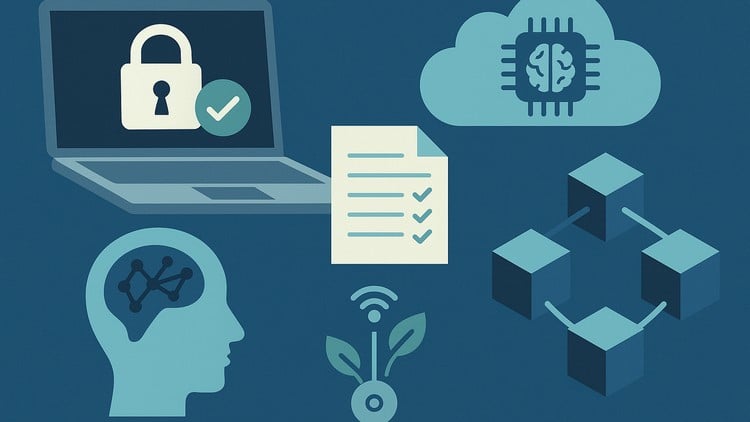
Apply ISO 27001:2022 to AI, IoT, Cloud & Blockchain with Risk Mapping, Control Selection, and Audit Preparation
⏱️ Length: 1.0 total hours
⭐ 5.00/5 rating
👥 1,784 students
🔄 September 2025 update
Add-On Information:
Note➛ Make sure your 𝐔𝐝𝐞𝐦𝐲 cart has only this course you're going to enroll it now, Remove all other courses from the 𝐔𝐝𝐞𝐦𝐲 cart before Enrolling!
- Course Overview
- The ISO 27001:2022 for Emerging Technologies course is a forward-thinking masterclass designed to bridge the gap between traditional Information Security Management Systems (ISMS) and the rapidly evolving landscape of Artificial Intelligence (AI), Internet of Things (IoT), Cloud Computing, and Blockchain.
- Participants will examine the ISO 27001:2022 standard update, specifically focusing on how the transitioned Annex A controls—now organized into four concise themes—address the unique vulnerabilities inherent in decentralized and autonomous systems.
- This course provides a deep dive into the context of the organization, helping leaders determine how emerging tech impacts the scope of their security perimeter when physical and digital boundaries are blurred by IoT sensors and edge computing.
- Students will learn to navigate the Statement of Applicability (SoA) specifically for environments that utilize Large Language Models (LLMs) and Generative AI, ensuring that data residency and algorithmic transparency are accounted for in compliance audits.
- The curriculum highlights the intersection of Blockchain technology and information integrity, demonstrating how distributed ledger technology (DLT) can be used both as a security control and as a complex asset requiring its own unique risk treatment plan.
- The training moves beyond theory by offering Risk Mapping exercises that align the 93 controls of the 2022 revision with the specific operational realities of multi-cloud and hybrid-cloud architectures.
- Learners will gain insights into the lifecycle of emerging tech, from the initial procurement of AI tools to the eventual decommissioning of IoT devices, ensuring constant alignment with the Plan-Do-Check-Act (PDCA) cycle.
- The course also addresses the regulatory intersection between ISO 27001 and other frameworks like the EU AI Act and ISO/IEC 42001, providing a holistic view of modern compliance requirements for tech-driven firms.
- Requirements / Prerequisites
- A fundamental understanding of the ISO 27001 framework is recommended, though a brief refresher on the 2022 updates is provided to ensure all students are on the same page regarding the transition from the 2013 version.
- General familiarity with Information Technology (IT) concepts, such as API integrations, cloud service models (SaaS, PaaS, IaaS), and basic data encryption, will help in understanding the technical control applications.
- An interest in organizational risk management and the willingness to think critically about how automation can both assist and hinder traditional security monitoring processes.
- No specific software coding skills are required, as the course focuses on the governance, risk, and compliance (GRC) layer rather than low-level technical implementation or programming.
- Access to a copy of the ISO/IEC 27001:2022 and ISO/IEC 27002:2022 standards is helpful for reference, though the core concepts are explained thoroughly within the video modules.
- Skills Covered / Tools Used
- Risk Assessment Methodologies: Mastery of identifying emerging technology threats, such as smart contract vulnerabilities and IoT botnet attacks, using quantitative and qualitative risk analysis.
- Control Selection & Tailoring: Learning to select and customize Annex A controls—such as Configuration Management (8.9) and Information Security in Supplier Relationships (5.19)—specifically for AI vendors and cloud providers.
- Audit Preparation: Developing the skills to lead an internal audit or prepare for a Stage 1/Stage 2 certification audit by documenting evidence of AI model monitoring and IoT device hardening.
- Compliance Mapping Tools: Using risk heat maps and gap analysis templates to visualize where an organization currently stands compared to the ISO 27001:2022 requirements.
- Strategic Security Governance: Learning how to draft Information Security Policies that encompass BYOD (Bring Your Own Device) policies for IoT and usage guidelines for corporate AI tools.
- Incident Response Planning: Creating specialized incident response playbooks for data breaches involving decentralized databases or cloud-native application failures.
- Benefits / Outcomes
- Future-Proof Your Career: Position yourself as a compliance expert capable of handling the next generation of technological disruption, making you an invaluable asset to fintech, healthtech, and AI-driven startups.
- Reduced Compliance Friction: Learn how to integrate ISO 27001 into Agile and DevOps workflows, ensuring that emerging tech development is “secure by design” without slowing down innovation.
- Enhanced Stakeholder Trust: Gain the ability to provide tangible assurance to board members and external clients that AI and Blockchain initiatives are governed by a globally recognized security standard.
- Optimized Control Efficiency: Discover how to use the ISO 27001:2022 structure to consolidate controls, reducing the administrative burden of managing security across multiple cloud environments.
- Advanced Problem Solving: Develop the mindset to tackle ambiguous security challenges, such as managing privacy in a public blockchain or securing autonomous IoT systems.
- Certification Readiness: Equip your organization with the documentation and control evidence necessary to achieve ISO 27001:2022 certification in a complex, modern tech environment.
- PROS
- Niche Focus: Unlike generic courses, this addresses the specific security nuances of high-growth technologies like AI and IoT.
- Up-to-Date Content: Specifically tailored to the 2022 version of the standard, ensuring all information is relevant for current and future audit cycles.
- Efficiency: Distills complex compliance mapping into a one-hour intensive session, perfect for busy professionals who need actionable insights quickly.
- Cross-Disciplinary Approach: Successfully blends legal compliance, technical security, and business risk management into one cohesive framework.
- High Value-to-Time Ratio: Covers four major technologies and a global standard in a streamlined format that focuses only on high-impact information.
- CONS
- Strategic Focus: The course is designed for governance and risk strategy, meaning it may not provide the hands-on command-line technical training some deep-level security engineers might seek for real-time ethical hacking.
Learning Tracks: English,IT & Software,Network & Security
Found It Free? Share It Fast!