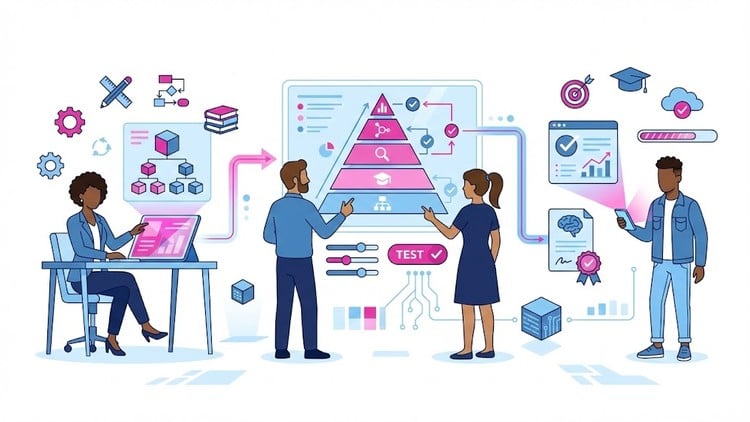
Understand and apply Bloom’s taxonomy to enrich educational strategies and objectives.
👥 140 students
🔄 August 2025 update
Add-On Information:
Note➛ Make sure your 𝐔𝐝𝐞𝐦𝐲 cart has only this course you're going to enroll it now, Remove all other courses from the 𝐔𝐝𝐞𝐦𝐲 cart before Enrolling!
- Course Overview
- This intensive course delves into the practical application of Bloom’s Taxonomy, moving beyond theoretical understanding to empower educators with tangible skills for curriculum design and assessment.
- Participants will explore how to systematically deconstruct learning objectives and create aligned instructional strategies and assessment tools that foster higher-order thinking.
- The program emphasizes a hands-on approach, enabling learners to translate abstract taxonomic levels into concrete classroom activities and evaluation methods.
- We will examine various interpretations and modern adaptations of Bloom’s Taxonomy, equipping educators to choose the most effective framework for their specific teaching context.
- A significant focus will be placed on crafting valid and reliable assessment instruments that accurately measure student achievement across the cognitive domains outlined by Bloom.
- The course encourages a critical analysis of existing curricula to identify areas where Bloom’s Taxonomy can be effectively integrated for enhanced learning outcomes.
- Participants will engage with case studies and real-world examples of successful curriculum development informed by taxonomic principles.
- The learning environment will foster collaborative exploration and peer-to-peer learning, allowing for shared insights and problem-solving in curriculum design.
- Upon completion, participants will possess a robust toolkit for developing and refining educational programs that promote deep understanding and critical engagement.
- This course is ideal for educators seeking to elevate their instructional design and assessment practices with a structured, research-backed framework.
- Requirements / Prerequisites
- A foundational understanding of educational principles and pedagogical concepts is beneficial but not strictly required.
- Participants should possess a willingness to actively engage in practical exercises and apply learned concepts to their teaching scenarios.
- Access to a computer with internet connectivity for potential online resources and collaborative activities.
- An open mind to exploring different approaches to curriculum design and assessment.
- Skills Covered / Tools Used
- Objective Writing: Crafting clear, measurable, achievable, relevant, and time-bound (SMART) learning objectives aligned with Bloom’s Taxonomy.
- Instructional Design: Developing lesson plans, activities, and teaching strategies that systematically target different levels of cognitive complexity.
- Assessment Creation: Designing diverse assessment types (e.g., quizzes, essays, projects, presentations) that accurately evaluate learning at each taxonomic level.
- Bloom’s Taxonomy Application: In-depth understanding and application of all cognitive levels: Remembering, Understanding, Applying, Analyzing, Evaluating, and Creating.
- Curriculum Mapping: Visualizing the progression of learning objectives and assessments across units and courses.
- Rubric Development: Creating effective rubrics for evaluating performance-based assessments at various cognitive levels.
- Differentiated Instruction Support: Leveraging Bloom’s Taxonomy to design instruction that caters to diverse learner needs.
- Data Analysis for Improvement: Interpreting assessment results to inform future curriculum adjustments.
- Collaborative Curriculum Planning: Utilizing digital tools and strategies for group curriculum development.
- Critical Pedagogy Integration: Exploring how Bloom’s Taxonomy can support critical thinking and problem-solving in educational contexts.
- Benefits / Outcomes
- Enhanced Instructional Clarity: Develop objectives and activities that are precisely aligned and easily understood by students.
- Improved Student Engagement: Design lessons that move beyond rote memorization to foster active learning and critical thinking.
- More Accurate Assessment: Create assessments that truly measure what students have learned and can do, reflecting their cognitive abilities.
- Systematic Curriculum Development: Gain a structured framework for designing, reviewing, and revising curricula for greater effectiveness.
- Increased Educator Confidence: Feel more assured in your ability to design impactful learning experiences.
- Facilitation of Higher-Order Thinking Skills: Equip students with the essential skills needed for success in complex academic and professional environments.
- Development of Transferable Skills: Acquire a universally recognized framework applicable across various subjects and educational levels.
- Contribution to Program Improvement: Play a key role in enhancing the quality and impact of educational programs.
- Greater Insight into Learning Processes: Deepen your understanding of how students learn and how to best support their cognitive growth.
- Professional Development: Elevate your professional toolkit and standing as an educator committed to best practices.
- PROS
- Provides a structured and research-backed framework for curriculum design.
- Empowers educators to move beyond basic recall to foster deeper learning.
- Enhances the validity and reliability of educational assessments.
- Promotes a systematic and logical approach to instructional planning.
- Universally applicable across different subjects and educational levels.
- CONS
- Requires dedicated time and effort for proper implementation and adaptation.
Learning Tracks: English,Teaching & Academics,Other Teaching & Academics
Found It Free? Share It Fast!