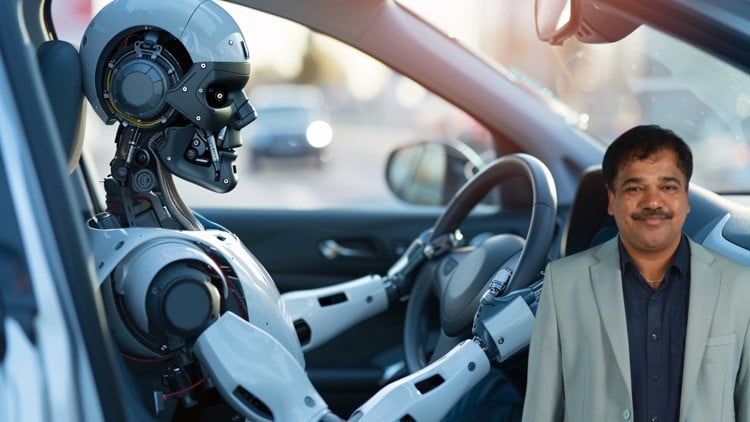
Artificial Intelligence, automations, IoT, Self-driving, computer Vision, real-time detection, Arduino and Python
⏱️ Length: 4.6 total hours
⭐ 5.00/5 rating
👥 768 students
🔄 October 2025 update
Add-On Information:
Note➛ Make sure your 𝐔𝐝𝐞𝐦𝐲 cart has only this course you're going to enroll it now, Remove all other courses from the 𝐔𝐝𝐞𝐦𝐲 cart before Enrolling!
-
Course Overview
- This comprehensive course guides you through the exciting process of constructing a miniature self-controlled car, integrating cutting-edge Artificial Intelligence (AI) inference capabilities with real-time Internet of Things (IoT) technologies. You will learn to transform theoretical knowledge into a tangible, autonomous system capable of understanding and reacting to its environment.
- Embark on a hands-on journey to bridge the gap between software algorithms and physical hardware, bringing a robotic vehicle to life. This involves understanding the intricate interplay of sensors, microcontrollers, and powerful AI models to achieve automated navigation and decision-making.
- Explore the foundational concepts of computer vision as applied to autonomous driving, learning how a machine “sees” and interprets visual information. This includes techniques for object detection, lane keeping, and obstacle avoidance, crucial for any self-driving application.
- Discover the essentials of real-time detection and responsiveness, ensuring your self-controlled car can make immediate, informed decisions based on live sensor data. This involves optimizing AI models for low-latency processing on embedded devices.
- Unravel the architecture behind creating smart, interconnected devices, specifically focusing on how your car collects environmental data via IoT sensors and communicates it for intelligent processing. This introduces core concepts of distributed intelligence in embedded systems.
-
Requirements / Prerequisites
- A foundational understanding of Python programming, including basic syntax, data structures, and control flow. Familiarity with object-oriented programming concepts will be advantageous, although not strictly required.
- Basic familiarity with electronics concepts, such as understanding circuits, voltage, current, and how simple sensors operate. No deep electrical engineering background is necessary, but a willingness to learn hardware interaction is key.
- Access to a personal computer (Windows, macOS, or Linux) with administrative rights to install necessary software and development environments. An internet connection is also required for downloading libraries and course materials.
-
Skills Covered / Tools Used
- Master the integration of diverse hardware components, including motors, servos, and various environmental sensors, into a cohesive functional unit. You will learn practical wiring and circuit assembly techniques for embedded systems.
- Develop proficiency in using Arduino microcontrollers as the brain for controlling physical actuators and interfacing with sensors, writing firmware to orchestrate the car’s movements and data collection.
- Implement advanced Python libraries for image processing and analysis, specifically leveraging OpenCV to interpret live video feeds from the car’s camera for navigational cues and object recognition.
- Gain experience in deploying lightweight AI inference models onto resource-constrained devices, ensuring efficient and fast execution of machine learning algorithms for real-time decision-making on the vehicle.
- Learn to establish robust IoT communication protocols, enabling the car to send status updates or receive commands wirelessly, creating a connected and controllable autonomous system.
- Acquire debugging skills for both hardware and software, effectively troubleshooting common issues that arise when integrating physical components with complex algorithmic logic.
-
Benefits / Outcomes
- Construct a fully functional, self-controlled car prototype, serving as a powerful demonstration of your applied skills in AI, IoT, and embedded systems, perfect for your professional portfolio.
- Develop a holistic understanding of the entire workflow for creating autonomous solutions, from sensor data acquisition and processing to AI-driven decision-making and motor control.
- Be well-equipped to undertake more complex projects in robotics, smart automation, and the burgeoning field of autonomous vehicles, with a solid practical foundation.
- Enhance your problem-solving abilities by tackling real-world challenges in system integration, algorithm optimization, and hardware-software interaction within a tangible project.
-
PROS
- Provides an exceptional opportunity for hands-on, project-based learning, transforming theoretical concepts into a working, real-world application that can be showcased.
- Directly addresses high-demand skills in AI, IoT, and autonomous systems, significantly boosting your employability and relevance in the modern tech landscape.
- Offers a comprehensive, end-to-end view of building an intelligent system, providing invaluable experience for aspiring roboticists, AI engineers, and embedded developers.
-
CONS
- Successfully completing the course’s practical components might necessitate acquiring specific hardware components, which represents an additional financial investment beyond the course fee.
Learning Tracks: English,Development,Data Science
Found It Free? Share It Fast!