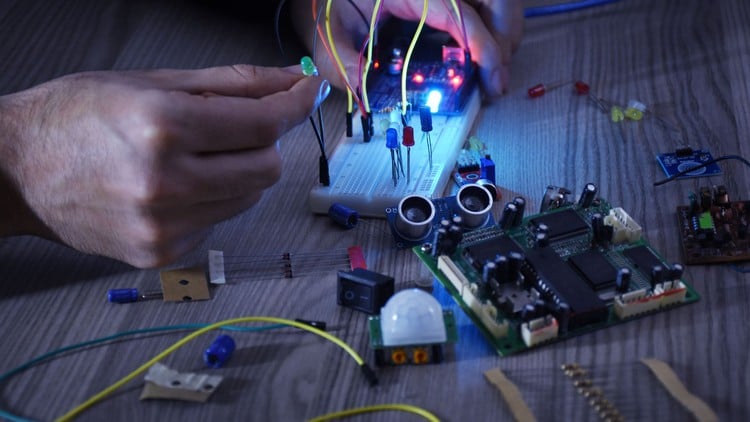
Master Arduino UNO Starting From Zero – Learn with Hands-on Activities and Many Arduino Projects.
⏱️ Length: 4.5 total hours
⭐ 4.37/5 rating
👥 46,123 students
🔄 June 2024 update
Add-On Information:
Note➛ Make sure your 𝐔𝐝𝐞𝐦𝐲 cart has only this course you're going to enroll it now, Remove all other courses from the 𝐔𝐝𝐞𝐦𝐲 cart before Enrolling!
-
Course Overview
- This “Arduino UNO Bootcamp For Beginners” serves as your rapid induction into the exciting realm of physical computing and embedded systems, meticulously crafted for individuals with absolutely no prior experience.
- Designed as an intensive, hands-on journey, this course prioritizes practical application over abstract theory, ensuring you actively build and experiment from the very first lesson.
- In a concise yet comprehensive 4.5 hours, you will transition from understanding basic electronic components to confidently programming the Arduino UNO to interact with the real world, culminating in the ability to create sophisticated, interactive projects.
- The curriculum is structured to foster a deep understanding of how software commands translate into physical actions, bridging the gap between digital code and tangible outcomes.
- With an impressive track record of over 46,000 students and a high rating, this course is a proven pathway to kickstarting your maker journey, updated as of June 2024 to ensure relevance with current best practices and component availability.
- It’s more than just learning to code; it’s about developing an intuitive grasp of electronics, troubleshooting methodologies, and the iterative design process inherent in hardware development.
- This bootcamp isn’t merely about completing projects; it’s about empowering you with the foundational knowledge and confidence to invent, innovate, and bring your own creative technological ideas to life using the versatile Arduino UNO platform.
- You will gain an appreciation for the interplay between microcontrollers, sensors, and actuators, setting a robust foundation for more advanced topics in robotics, smart devices, and interconnected systems.
-
Requirements / Prerequisites
- Absolutely no prior programming or electronics knowledge is necessary; this course starts from the absolute basics, assuming you are a complete beginner.
- A working desktop or laptop computer (Windows, macOS, or Linux) capable of running the Arduino IDE software.
- A stable internet connection to download the necessary software and access course materials.
- A genuine or compatible Arduino UNO board (or an equivalent ATmega328P-based development board) is essential for hands-on activities.
- A USB A-to-B cable to connect your Arduino UNO to your computer for programming and power.
- A basic starter kit of electronic components is highly recommended and virtually mandatory to follow along with the projects. This typically includes:
- A breadboard (for prototyping circuits).
- Various resistors (e.g., 220 Ohm, 1k Ohm, 10k Ohm).
- LEDs of different colors.
- Push buttons and potentiometers.
- Jumper wires (male-to-male, male-to-female).
- Common sensors like a photoresistor (LDR), temperature sensor (e.g., LM35 or DHT11), and an ultrasonic distance sensor (HC-SR04).
- Actuators such as a small DC motor, a servo motor (e.g., SG90), and a motor driver module (e.g., L298N for the robot car project).
- A small buzzer.
- A strong willingness to learn, experiment, and troubleshoot; patience is key in physical computing.
- Basic computer literacy, including downloading files, installing software, and navigating your operating system.
-
Skills Covered / Tools Used
- Microcontroller Programming Fundamentals: Grasping the C/C++ syntax tailored for Arduino, including variables, data types, control flow (if/else, loops), and functions.
- Digital and Analog I/O Control: Mastering how to read digital inputs (buttons), write digital outputs (LEDs), read analog inputs (potentiometers, LDRs), and generate analog outputs (PWM for dimming LEDs or controlling motor speed).
- Basic Circuit Construction: Developing proficiency in prototyping electronic circuits on a breadboard, understanding component placement, and ensuring proper connections.
- Sensor Interfacing: Learning to connect, read data from, and integrate a variety of common sensors, including proximity, light, temperature, and basic motion sensors.
- Actuator Control: Gaining expertise in driving different types of actuators, such as LEDs, buzzers, DC motors (with motor drivers), and servo motors for precise angular control.
- Serial Communication: Utilizing the Arduino’s serial monitor for debugging code, monitoring sensor readings, and sending commands to the Arduino from your computer.
- Introduction to Libraries: Understanding the concept of Arduino libraries and how to use them to extend functionality for complex components like servo motors or specific sensors.
- Basic Robotics Principles: Implementing foundational concepts for autonomous movement, including obstacle detection and simple navigation algorithms for mobile platforms.
- Embedded Systems Logic: Developing a conceptual understanding of how microcontrollers execute code to perform specific tasks within a dedicated system.
- Debugging and Troubleshooting: Acquiring essential skills to identify and resolve both software programming errors and common hardware wiring issues.
- Prototyping Tools: Hands-on use of the Arduino IDE (Integrated Development Environment), Arduino UNO board, breadboards, jumper wires, and a diverse range of electronic components (resistors, capacitors, diodes, transistors, etc.).
- Specific Components Utilized: LEDs, pushbuttons, potentiometers, photoresistors (LDR), temperature sensors (e.g., LM35), ultrasonic distance sensors (HC-SR04), small DC motors, servo motors (e.g., SG90), and motor driver modules (e.g., L298N).
-
Benefits / Outcomes
- Confidently Prototype Hardware: You will gain the ability to conceptualize, design, and build your own basic electronic projects from scratch, bringing your ideas into physical reality.
- Solid Foundational Understanding: Establish a strong base in electronics, programming logic, and embedded systems, preparing you for more advanced topics in robotics, IoT development, and custom circuit design.
- Enhanced Problem-Solving Skills: Develop a systematic approach to debugging both software code and hardware connections, fostering critical thinking and analytical abilities.
- Empowerment through Creation: Experience the profound satisfaction of creating functional gadgets and interactive systems that respond to their environment.
- Maker Community Readiness: Be well-equipped to engage with the global maker community, understand technical discussions, and contribute to open-source hardware projects.
- Practical Application of Theory: Connect theoretical knowledge of electrical circuits and programming concepts directly to tangible, working prototypes.
- Gateway to STEM Fields: This course serves as an excellent entry point for hobbyists and aspiring engineers interested in pursuing careers in electronics, mechatronics, automation, or software development for hardware.
- Develop a Creative Mindset: Foster innovation and creativity by understanding the tools and techniques needed to transform imaginative concepts into functional devices.
- Independent Project Development: Acquire the skills necessary to independently research, design, and implement solutions for personal or academic electronic projects.
-
PROS
- Highly practical and project-driven approach, maximizing hands-on learning.
- Designed specifically for absolute beginners, requiring zero prior knowledge.
- Exceptional student engagement and popularity with thousands of positive reviews.
- Concise duration allows for rapid skill acquisition and quick project completion.
- Content is regularly updated, ensuring relevance and incorporating best practices.
- Provides a robust foundation for diverse advanced topics like robotics and smart devices.
- Budget-friendly, as it leverages readily available and affordable Arduino UNO kits and components.
-
CONS
- The relatively short duration means very deep dives into highly complex theoretical concepts or advanced programming techniques are limited.
Learning Tracks: English,IT & Software,Hardware
Found It Free? Share It Fast!