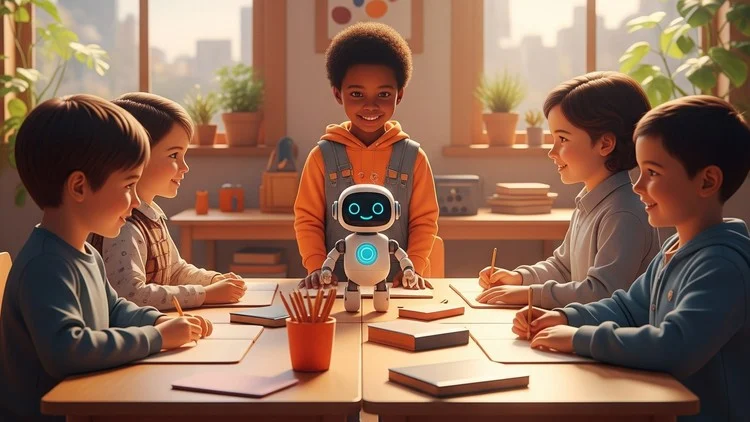
Discover how kids can explore AI through games, stories, and activities that make learning fun and easy.
⏱️ Length: 2.3 total hours
⭐ 4.24/5 rating
👥 6,348 students
🔄 February 2026 update
Add-On Information:
Note➛ Make sure your 𝐔𝐝𝐞𝐦𝐲 cart has only this course you're going to enroll it now, Remove all other courses from the 𝐔𝐝𝐞𝐦𝐲 cart before Enrolling!
- COURSE OVERVIEW
- Foundational AI Literacy: This course bridges the gap between science and a child’s curiosity, ensuring they understand the logical inner workings powering their daily digital world.
- Story-Driven Education: Relatable narratives and characters explain how machines learn from mistakes, helping humans solve real-world problems in an approachable, fun, and memorable way.
- Interactive Gamification: Replaces lectures with mini-games where children train virtual assistants and solve logic puzzles using the core principles of algorithmic thinking and patterns.
- Visual Learning Techniques: Uses colorful diagrams and drag-and-drop interfaces to illustrate neural networks and data processing pipelines in a manner young minds can easily grasp.
- Safety-First Digital Citizenship: Students learn to navigate the digital world securely, understanding online privacy while experimenting with age-appropriate AI tools and applications in a safe environment.
- REQUIREMENTS / PREREQUISITES
- Zero Coding Experience: Built for absolute beginners; no prior knowledge of Python, Java, or any programming language is required to grasp concepts or participate in activities.
- Basic Digital Proficiency: Students should know how to use a mouse, navigate a web browser, and interact with basic online games or digital educational platforms.
- Standard Hardware Access: Any modern laptop, desktop, or tablet with stable internet is sufficient to access web-based materials without needing heavy software installations.
- Supervised Discovery: While kid-friendly, a guardian is encouraged to assist during initial account setups for creative tools to ensure a safe and secure environment.
- SKILLS COVERED / TOOLS USED
- Pattern Recognition Mastery: Children learn how AI identifies shapes and sounds through datasets, helping them understand how machines “see” and differentiate various objects in photographs.
- Creative Prompt Engineering: Students communicate with AI by crafting descriptive instructions for image generation, improving their vocabulary, descriptive writing skills, and ability to give clear directions.
- Data Classification Fundamentals: Understanding how to categorize vast information so machines make accurate predictions, teaching children core concepts of data organization and logical sorting techniques.
- Voice Recognition Mechanics: Exploring how smart assistants understand human speech through acoustic modeling, simplified to explain why devices sometimes misunderstand spoken commands or various accents.
- Ethical Decision-Making: Discussing the importance of fairness in technology through age-appropriate scenarios where kids decide what is “fair” or “unfair” for a robot to do.
- Logic Tree Construction: Utilizing visual programming blocks to create decision-making trees, allowing kids to see how simple rules govern the behavior of intelligent software systems.
- Safe Generative Art: Utilizing curated, kid-safe platforms to generate AI imagery, allowing students to see the creative impact of their written prompts while following digital safety guidelines.
- Visual Block Coding: Using tools similar to Scratch that incorporate AI extensions, enabling children to build functional models without having to type complex code or syntax.
- BENEFITS / OUTCOMES
- Building Digital Confidence: Kids transition from passive technology consumers to active creators who understand digital mechanics, giving them mastery and confidence in a rapidly changing landscape.
- Enhanced Problem-Solving Skills: The course encourages logical deconstruction of problems, a skill translating directly to success in mathematics, science projects, and everyday critical thinking tasks.
- Future Career Awareness: Introducing AI concepts early gives children a competitive edge and a clear understanding of future job landscapes in technology, engineering, and creative arts.
- Fostering Creative Expression: Using AI tools as collaborators to generate art and stories fosters a unique blend of technology and imagination, encouraging kids to see computers creatively.
- Developing Critical Thinking: Students learn to question machine-provided information, fostering healthy digital skepticism and fact-verification skills crucial for navigating the modern era of automated information.
- PROS
- Engagement-Focused Design: Short, fast-paced video segments match young attention spans, ensuring students remain focused and excited without feeling overwhelmed by technical jargon or long lectures.
- Updated 2026 Curriculum: Features the February 2026 update with the latest advancements in generative technology, making it a current and relevant resource for modern young learners.
- Proven Global Success: Educating over 6,348 students with a strong rating, the curriculum is battle-tested and refined based on feedback from thousands of parents and educators.
- Optimized Course Duration: At exactly 2.3 hours, the course provides a comprehensive yet concise introduction perfect for weekend enrichment without causing digital fatigue or screen time.
- CONS
- Introductory Complexity Only: Because the course focuses on simplicity and accessibility, it may not offer enough technical depth for older teenagers with prior advanced coding experience.
Learning Tracks: English,Development,Data Science
Found It Free? Share It Fast!