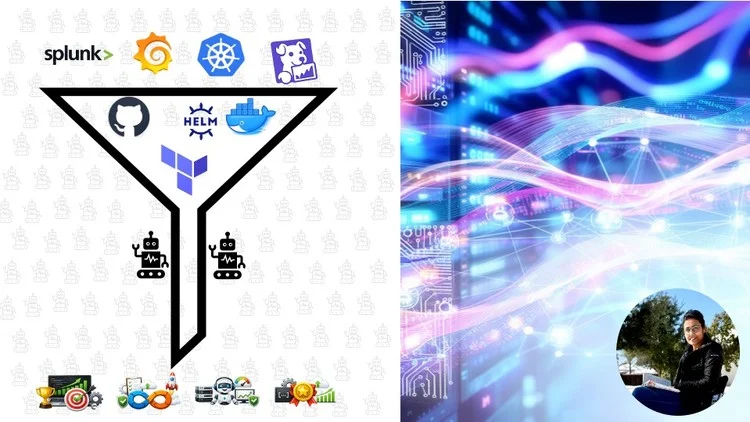
Build intelligent, reliable systems using AI, AIOps, and real-world SRE practices
⏱️ Length: 4.0 total hours
👥 55 students
🔄 February 2026 update
Add-On Information:
Note➛ Make sure your 𝐔𝐝𝐞𝐦𝐲 cart has only this course you're going to enroll it now, Remove all other courses from the 𝐔𝐝𝐞𝐦𝐲 cart before Enrolling!
- Course Overview: This program offers a deep dive into the paradigm shift from traditional Site Reliability Engineering to the intelligence-driven era of AIOps, focusing on how to manage hyper-scale environments with minimal manual intervention.
- Course Overview: You will explore the strategic integration of machine learning models into existing DevOps workflows to move beyond reactive firefighting and toward a culture of proactive, predictive system management.
- Course Overview: The curriculum bridges the gap between raw data collection and actionable intelligence, teaching you how to architect observability pipelines that filter noise and highlight genuine systemic anomalies.
- Course Overview: Participants will analyze the lifecycle of an automated incident, from the moment an AI agent detects a deviation in performance metrics to the execution of a self-healing script that restores service without human oversight.
- Course Overview: The course emphasizes the ethical and practical considerations of deploying AI in production, ensuring that your automated systems remain transparent, interpretable, and aligned with organizational safety standards.
- Course Overview: Through a series of architectural blueprints, you will learn how to design a “Single Pane of Truth” that leverages Large Language Models (LLMs) to provide real-time status updates and root cause summaries for complex microservices.
- Requirements / Prerequisites: A foundational understanding of the software development lifecycle (SDLC) and experience working within a standard DevOps environment is highly recommended to grasp the advanced automation concepts.
- Requirements / Prerequisites: Learners should possess a basic proficiency in Python or similar scripting languages, as the course involves writing automation scripts and interacting with machine learning application programming interfaces.
- Requirements / Prerequisites: Familiarity with cloud infrastructure providers such as AWS, Azure, or Google Cloud Platform is essential, as the practical examples are built upon containerized environments and managed cloud services.
- Requirements / Prerequisites: An introductory knowledge of monitoring concepts like metrics, logs, and traces will help you better understand how AI algorithms process observability data to find patterns.
- Skills Covered / Tools Used: Mastery of Anomaly Detection algorithms, specifically focusing on how to implement Isolation Forests and Long Short-Term Memory (LSTM) networks for predicting infrastructure failures before they occur.
- Skills Covered / Tools Used: Implementation of OpenTelemetry for standardized data collection, ensuring that your AIOps platform can ingest high-quality data from diverse polyglot microservices without vendor lock-in.
- Skills Covered / Tools Used: Hands-on experience with specialized AIOps tools and platforms such as Moogsoft, BigPanda, or Datadog’s Watchdog to automate event correlation and drastically reduce alert fatigue.
- Skills Covered / Tools Used: Leveraging Generative AI and LLM agents to automate the creation of post-mortem reports and to translate complex system logs into natural language insights for non-technical stakeholders.
- Skills Covered / Tools Used: Development of Intelligent Auto-scaling policies that use predictive analytics rather than static CPU/memory thresholds, optimizing cloud spend while maintaining high availability during traffic spikes.
- Skills Covered / Tools Used: Utilization of vector databases and retrieval-augmented generation (RAG) to build internal SRE knowledge bases that allow engineers to query historical incident data using natural language.
- Benefits / Outcomes: You will achieve a significant reduction in Mean Time to Detect (MTTD) and Mean Time to Recovery (MTTR) by replacing manual investigation with automated, AI-driven root cause analysis.
- Benefits / Outcomes: Graduates will be able to design “Self-Healing” infrastructures that automatically trigger remediation workflows, allowing the engineering team to focus on high-value feature development instead of repetitive maintenance.
- Benefits / Outcomes: The course empowers you to transform your organization’s on-call experience by filtering out 90% of non-actionable alerts, thereby preventing engineer burnout and improving overall team morale.
- Benefits / Outcomes: You will gain the expertise to align technical performance metrics with business outcomes, using AI to demonstrate how system reliability directly impacts customer satisfaction and revenue retention.
- Benefits / Outcomes: Upon completion, you will possess a future-proof skill set that positions you at the forefront of the infrastructure engineering market, ready to lead AI transformation initiatives within large-scale enterprises.
- Benefits / Outcomes: You will learn to build a quantitative framework for Service Level Objectives (SLOs) where AI helps define realistic error budgets based on historical performance trends and user behavior.
- PROS: Features cutting-edge content updated for the 2026 landscape, including the latest advancements in SRE-specific Generative AI applications.
- PROS: Focuses on vendor-neutral methodologies, ensuring the skills you learn are applicable regardless of whether your company uses open-source tools or proprietary enterprise platforms.
- PROS: Provides practical, lab-based scenarios that simulate high-pressure production outages, giving you a safe environment to test AI-driven remediation strategies.
- CONS: The technical depth of the machine learning sections may require additional external study for students who have no prior exposure to basic data science or statistical concepts.
Learning Tracks: English,IT & Software,Other IT & Software
Found It Free? Share It Fast!