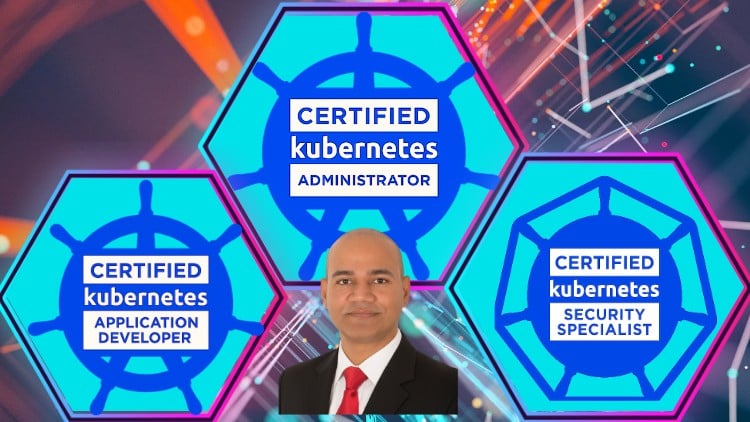
Certified Kubernetes Administrator/Application Developer/Security Specialist Exam | Hands-on | Scenario Based Questions
⏱️ Length: 15.3 total hours
⭐ 4.47/5 rating
👥 43,880 students
🔄 December 2025 update
Add-On Information:
Note➛ Make sure your 𝐔𝐝𝐞𝐦𝐲 cart has only this course you're going to enroll it now, Remove all other courses from the 𝐔𝐝𝐞𝐦𝐲 cart before Enrolling!
- Course Overview
- This intensive bootcamp is architected to provide a streamlined, high-velocity path toward mastering the entire Cloud Native Computing Foundation (CNCF) certification trio.
- Unlike traditional modular courses, this curriculum adopts a holistic approach by interweaving administrative tasks, application design patterns, and rigorous security hardening into a single unified learning journey.
- The syllabus is structured to dismantle the complexities of the Kubernetes API, focusing on how different components—from the Kube-APIServer to the Kubelet—interact in a production-grade environment.
- Participants will engage with the internal mechanics of etcd, exploring how state is maintained and the critical role of consensus in distributed systems management.
- The course places a heavy emphasis on the declarative nature of Kubernetes, training students to think in terms of desired states rather than manual, imperative interventions.
- Special attention is given to the lifecycle of a Pod, tracking its journey from scheduling via the Kube-Scheduler to its execution on a specific worker node.
- The content is specifically calibrated for the December 2025 update, ensuring that deprecated features are removed and the latest security benchmarks and API versions are fully integrated.
- This is not merely a theoretical walkthrough; it is a terminal-centric experience designed to build the muscle memory required for the high-pressure environment of live exams.
- Requirements / Prerequisites
- A fundamental understanding of the Linux operating system, including familiarity with file system hierarchies, permissions, and process management.
- Basic proficiency with the Command Line Interface (CLI), specifically the ability to navigate directories and manipulate text files using standard utilities.
- Conceptual knowledge of containerization technologies, such as Docker or Containerd, and an understanding of how images differ from running containers.
- Familiarity with networking concepts, including IP addressing, DNS resolution, and the basics of HTTP/HTTPS protocols.
- An introductory grasp of YAML syntax, as the majority of Kubernetes resource definitions rely on consistent indentation and key-value pair formatting.
- Access to a local or cloud-based environment where a Kubernetes cluster can be simulated, such as through Minikube, Kind, or a managed service like GKE/EKS.
- Skills Covered / Tools Used
- Kubeadm: Mastery of cluster bootstrapping, including the initialization of control planes and the joining of worker nodes using secure tokens.
- JSONPath and Custom Columns: Advanced data extraction techniques for filtering complex API responses into readable, actionable reports.
- RBAC (Role-Based Access Control): Implementation of granular security policies using ServiceAccounts, Roles, and ClusterRoleBindings to enforce the principle of least privilege.
- Network Policies: Crafting sophisticated ingress and egress rules to isolate workloads and secure the pod-to-pod communication path within the CNI.
- Helm: Utilizing the Kubernetes package manager to deploy, upgrade, and manage complex application stacks through templated charts.
- Trivy and Falco: Integration of third-party security tools for proactive image vulnerability scanning and reactive runtime threat detection.
- Pod Security Admission: Moving beyond deprecated Pod Security Policies to implement modern, namespace-level security standards.
- Admission Controllers: Configuring and troubleshooting mutating and validating webhooks to intercept and modify API requests.
- Ingress Controllers: Setting up NGINX or HAProxy based controllers to manage external traffic, SSL/TLS termination, and path-based routing.
- Persistence Strategies: Configuring PersistentVolumes (PV) and PersistentVolumeClaims (PVC) with various StorageClasses to handle stateful application requirements.
- Sidecar and Adapter Patterns: Designing multi-container pods to enhance application logging, monitoring, and proxying capabilities.
- Node Affinity and Taints: Orchestrating workload placement through advanced scheduling constraints to optimize resource utilization and high availability.
- Benefits / Outcomes
- Develop a comprehensive technical fluency that allows you to speak the language of DevOps, SRE, and Cloud-Native architecture with total confidence.
- Acquire the ability to architect resilient, self-healing systems that can automatically recover from node failures and application crashes.
- Gain a competitive edge in the global job market by obtaining the “Triple Crown” of Kubernetes certifications, signaling deep expertise to recruiters and stakeholders.
- Learn to optimize infrastructure costs by implementing effective resource quotas and horizontal autoscaling based on real-time demand.
- Transform your workflow from manual deployments to automated, configuration-as-code practices that align with modern CI/CD pipelines.
- Cultivate a security-first mindset that ensures clusters are hardened against both external attacks and internal misconfigurations from the ground up.
- Build the mental framework necessary to troubleshoot complex networking and storage issues that typically plague production environments.
- PROS
- High Density: The “Crash Course” format eliminates fluff, focusing exclusively on high-impact topics that translate directly to exam success and job performance.
- Unified Curriculum: By covering CKA, CKAD, and CKS together, students can see the overlaps and differences between the three domains, leading to better retention.
- Up-to-Date Labs: The Dec 2025 update ensures all hands-on exercises work with the current stable releases of Kubernetes (v1.31/1.32+).
- Strategic Efficiency: Provides a structured roadmap that prevents students from getting lost in the vast Kubernetes documentation, saving hundreds of hours of self-study.
- CONS
- Fast-Paced Intensity: This course assumes a certain level of technical maturity; absolute beginners who have never touched a command line may find the rapid progression challenging without additional foundational study.
Learning Tracks: English,IT & Software,IT Certifications
Found It Free? Share It Fast!