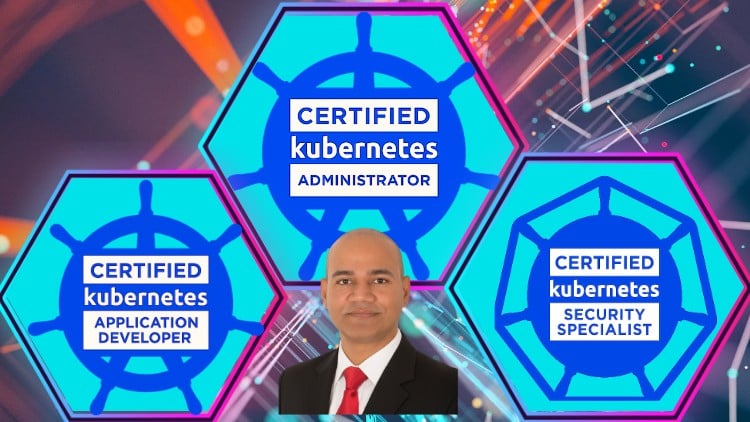
Certified Kubernetes Administrator/Application Developer/Security Specialist Exam | Hands-on | Scenario Based Questions
⏱️ Length: 14.9 total hours
⭐ 4.48/5 rating
👥 42,626 students
🔄 October 2025 update
Add-On Information:
Note➛ Make sure your 𝐔𝐝𝐞𝐦𝐲 cart has only this course you're going to enroll it now, Remove all other courses from the 𝐔𝐝𝐞𝐦𝐲 cart before Enrolling!
- Course Overview:
- Embark on an intensive, accelerated journey to conquer three of the most prestigious Kubernetes certifications: Certified Kubernetes Administrator (CKA), Certified Kubernetes Application Developer (CKAD), and Certified Kubernetes Security Specialist (CKS).
- This comprehensive crash course is meticulously designed for IT professionals aiming to achieve multi-faceted expertise in managing, developing, and securing cloud-native applications on Kubernetes.
- Spanning 14.9 total hours of focused instruction, the curriculum distills complex topics into actionable, exam-centric knowledge, ensuring maximum efficiency for your certification goals.
- Immerse yourself in a truly hands-on learning environment, where theoretical concepts are immediately reinforced with practical exercises and real-world configurations.
- Leverage the course’s stellar 4.48/5 rating from over 42,000 students, a testament to its effectiveness and the quality of its educational approach.
- Stay ahead of the curve with content updated to reflect the latest exam requirements and Kubernetes ecosystem changes, ensuring your preparation is current and relevant through October 2025.
- Beyond just passing exams, this course cultivates a holistic understanding of Kubernetes, preparing you for immediate impact in professional cloud-native roles.
- It serves as an all-in-one solution for anyone serious about becoming a proficient and certified Kubernetes expert across all key operational domains.
- Requirements / Prerequisites:
- A foundational grasp of Linux command-line operations is essential, as the exams are performance-based and heavily rely on terminal proficiency.
- Familiarity with basic containerization concepts, such as Docker, including understanding images, containers, and basic lifecycle management.
- Comfort with reading and writing YAML configuration files is highly beneficial, as Kubernetes predominantly uses YAML for resource definitions.
- A working knowledge of core networking concepts, including IP addressing, ports, and basic services, will aid in understanding Kubernetes networking.
- Possession of a strong drive and commitment to rapid learning, given the “crash course” format and the breadth of material covered.
- Access to a stable internet connection and a computer capable of running practice labs (details often provided by the course platform or instructor).
- While not strictly mandatory, prior exposure to cloud platforms or distributed systems concepts can provide a helpful contextual foundation.
- Skills Covered / Tools Used:
- Core Kubernetes Operations: Master the lifecycle management of essential Kubernetes objects like Pods, Deployments, ReplicaSets, StatefulSets, and DaemonSets.
- Cluster Configuration & Architecture: Gain proficiency in understanding and managing Kubernetes cluster components, including the API server, controller manager, scheduler, and etcd.
- Networking Fundamentals: Implement and troubleshoot Kubernetes networking, including Services, Ingress controllers, CoreDNS, and Network Policies.
- Persistent Storage Management: Configure and utilize Persistent Volumes (PVs), Persistent Volume Claims (PVCs), StorageClasses, and various volume types to ensure data persistence.
- Security Best Practices (CKS-focused): Implement robust security measures such as Role-Based Access Control (RBAC), Pod Security Standards, image scanning, and runtime security.
- Application Deployment & Debugging (CKAD-focused): Learn advanced deployment strategies, configuration management with ConfigMaps and Secrets, and effective debugging techniques for containerized applications.
- Troubleshooting & Maintenance (CKA-focused): Develop skills in diagnosing cluster issues, performing upgrades, backing up etcd, and managing node health.
- Essential CLI Tools: Become an expert user of `kubectl` for all Kubernetes interactions, along with supplementary tools like `etcdctl` for backup/restore and `jsonpath` for efficient data extraction.
- Container Runtime Interface (CRI): Understand the interaction between Kubernetes and container runtimes like containerd, crucial for cluster administration.
- Resource Management: Optimize resource utilization by defining requests and limits for containers and understanding scheduling implications.
- Observability Foundations: Implement basic logging and event monitoring within Kubernetes to track application and cluster health.
- Package Management: Leverage tools like Helm for streamlined application deployment and management within complex Kubernetes environments.
- Benefits / Outcomes:
- Achieve a unique distinction in the cloud-native landscape by holding three of the most respected and challenging Kubernetes certifications.
- Position yourself as a highly versatile and valuable professional capable of excelling in Kubernetes administration, application development, and security roles.
- Unlock significant career advancement opportunities, higher earning potential, and increased demand in the rapidly growing cloud computing industry.
- Gain deep, practical expertise that extends far beyond theoretical knowledge, preparing you for real-world operational challenges.
- Build the confidence to design, deploy, manage, and secure complex applications and infrastructure on Kubernetes from day one.
- Efficiently validate your comprehensive Kubernetes skill set through a structured and proven exam preparation methodology.
- Become an indispensable asset to organizations adopting or scaling Kubernetes, demonstrating mastery across the entire platform lifecycle.
- Develop a robust problem-solving mindset crucial for troubleshooting and optimizing Kubernetes environments effectively.
- Solidify your understanding of cloud-native principles, making you adaptable to evolving technologies and best practices.
- Join an elite group of certified professionals, enhancing your professional network and industry credibility.
- PROS:
- Provides a highly efficient and consolidated pathway to earning three top-tier Kubernetes certifications simultaneously.
- The “crash course” format is ideal for experienced professionals or those seeking rapid skill acquisition and certification.
- Exceptional student feedback and high enrollment numbers underscore the course’s quality and effectiveness.
- Ensures up-to-date content with regular revisions, keeping pace with the dynamic Kubernetes ecosystem and exam changes.
- Offers a well-rounded skill set, preparing you for diverse roles from cluster operations to application development and security.
- Strong emphasis on hands-on practice, which is crucial for success in performance-based certification exams.
- Covers a wide array of topics necessary for comprehensive Kubernetes mastery in a condensed timeframe.
- CONS:
- The intensive and fast-paced nature of a “crash course” might be overwhelming for absolute beginners without prior foundational knowledge or for those who prefer a more gradual learning approach.
Learning Tracks: English,IT & Software,IT Certifications
Found It Free? Share It Fast!