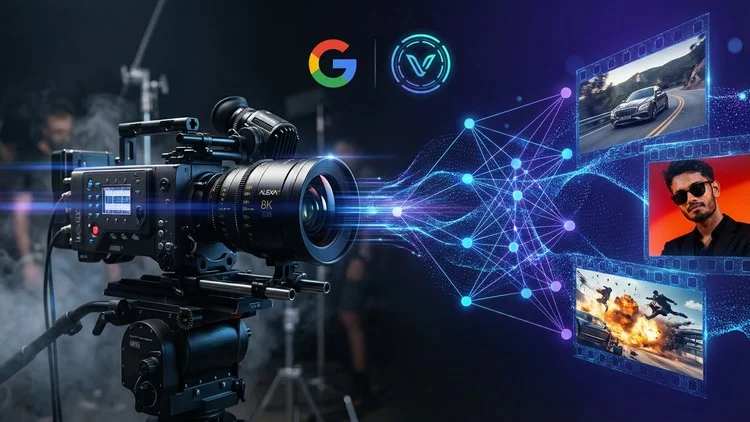
Master AI Video Creation Like a Pro Director – Build Stunning Commercials, Viral Content & Hollywood-Level Videos Using
⏱️ Length: 5.5 total hours
👥 191 students
🔄 February 2026 update
Add-On Information:
Note➛ Make sure your 𝐔𝐝𝐞𝐦𝐲 cart has only this course you're going to enroll it now, Remove all other courses from the 𝐔𝐝𝐞𝐦𝐲 cart before Enrolling!
- Comprehensive Architecture Deep Dive: This course provides an exhaustive exploration of the Google Veo 3.1 engine, moving beyond surface-level prompting to understand the underlying neural pathways that govern temporal stability and high-dynamic-range lighting. Students will explore how the 2026 update utilizes advanced Spatial-Temporal Transformers to maintain character consistency across multiple cinematic sequences, ensuring that every frame aligns with the director’s specific narrative vision.
- Cinematic Grammar and AI Synthesis: Participants will learn to translate traditional film school concepts—such as mise-en-scène, depth of field, and the rule of thirds—into the language of AI. We analyze how to instruct Veo 3.1 to simulate specific lens types, from 35mm anamorphic textures to 70mm IMAX clarity, allowing for the creation of digital footage that is indistinguishable from physical celluloid or high-end sensor capture.
- Narrative Prompt Engineering for Long-Form Media: Transition from generating ten-second clips to constructing full-scale cinematic acts. This section focuses on Recursive Prompting and Contextual Seeding, techniques designed to keep the AI aligned with a screenplay’s emotional beats and environmental shifts over the course of an extended production.
- Advanced Workflow Orchestration: Learn how to integrate Veo 3.1 into a professional post-production pipeline. We examine the interplay between AI generation and traditional editing software, focusing on how to export multichannel metadata and depth maps that are essential for modern visual effects (VFX) compositing and 3D environment reconstruction.
- Foundational Creative Direction: While technical skills can be taught, a basic understanding of visual storytelling and composition is required to maximize the output of the Veo 3.1 engine.
- Hardware and Connectivity Prerequisites: Students must have access to a workstation capable of handling 4K video playback and a stable high-bandwidth internet connection to interface with the Google Vertex AI cloud infrastructure efficiently.
- Software Licensing: An active subscription or trial access to Google Creative Lab’s pro-tier tools is necessary, as the course utilizes enterprise-level features not available in the public beta versions.
- Basic Post-Production Knowledge: Familiarity with non-linear editing (NLE) concepts, such as timeline management and basic color correction, will help in organizing the high volume of generative assets produced during the course.
- Google Veo 3.1 Pro Interface: Mastery of the Directorial Control Panel, which allows for real-time manipulation of camera vectors, focal lengths, and lighting temperatures within the generative environment.
- Dynamic Motion Control: Utilizing the Motion Sensitivity Slider to dictate the pace of action, from slow-motion “bullet time” sequences to high-speed kinetic chases without losing pixel integrity.
- Multi-Modal Input Strategy: Learning to use Image-to-Video and Video-to-Video workflows to refine existing footage or transform static concept art into living, breathing cinematic landscapes.
- Neural Audio Syncing: Implementation of integrated AI soundscapes that automatically generate diegetic sound effects and ambient textures based on the visual metadata provided by the Veo engine.
- Automated Color Grading Chains: Applying Lut-based Prompting to ensure that the color science of your AI-generated clips matches the specific aesthetic of Hollywood blockbusters or gritty indie dramas.
- Professional Competitive Edge: By mastering the 2026 update of Veo, you position yourself at the forefront of the Generative Cinema revolution, making you an invaluable asset to advertising agencies and film studios looking to reduce production costs.
- Rapid Prototyping Capabilities: Dramatically shorten the gap between ideation and visualization; what used to take weeks of storyboarding and pre-visualization can now be achieved in hours of high-fidelity AI rendering.
- Commercial Scalability: Gain the ability to produce viral-ready social media content and high-end commercial spots with a minimalist budget, bypassing the need for expensive location shoots and large production crews.
- Artistic Autonomy: Empowerment to create “Hollywood-level” visuals without the gatekeeping of traditional studio systems, allowing independent creators to realize complex sci-fi or fantasy epics with zero physical constraints.
- PROS: Cutting-Edge Curriculum: Covers the most recent 2026 breakthroughs in AI video synthesis that are not yet documented in mainstream tutorials.
- PROS: High Production Value: The course itself is a testament to the technology, featuring 4K cinematic examples and step-by-step walkthroughs of complex scene builds.
- PROS: Community Access: Enrollment includes entry into an exclusive director’s circle where students can collaborate on large-scale generative film projects.
- CONS: Resource Intensity: The high-level features of Veo 3.1 require a significant computational credit spend on Google Cloud, which may lead to additional costs for students outside of the course fee.
Learning Tracks: English,Photography & Video,Video Design
Found It Free? Share It Fast!