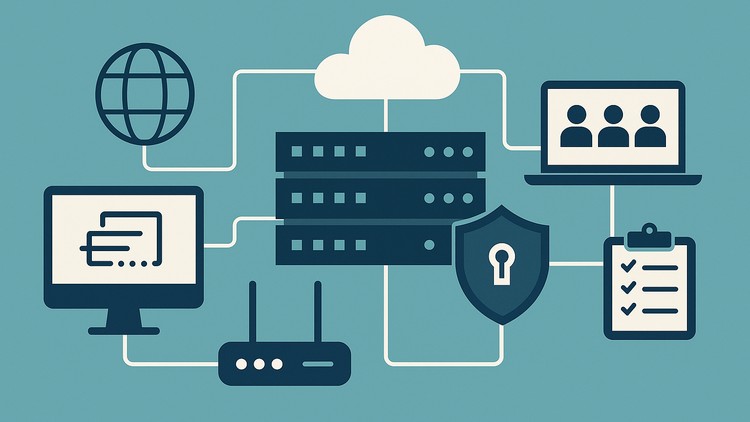
Master real-world network administration—inventory, access control, monitoring, security, compliance, & cloud management
⏱️ Length: 41 total minutes
👥 1,002 students
🔄 October 2025 update
Add-On Information:
Note➛ Make sure your 𝐔𝐝𝐞𝐦𝐲 cart has only this course you're going to enroll it now, Remove all other courses from the 𝐔𝐝𝐞𝐦𝐲 cart before Enrolling!
- Course Overview
- This “Network Administration in Practice: Managing Modern Networks” course offers an intensive, strategic deep dive into contemporary network administration.
- It’s specifically tailored for professionals navigating the complexities of both traditional on-premise infrastructure and dynamic cloud environments, updated as of October 2025.
- Despite its concise 41-minute duration, it delivers high-impact learning, distilling crucial knowledge for immediate real-world application.
- The curriculum emphasizes systematic processes for establishing and maintaining robust network hygiene, from hardware/software inventory to ensuring data integrity and service availability.
- Participants gain a holistic understanding of how foundational administrative tasks interweave with advanced security protocols and stringent compliance requirements across hybrid network architectures.
- It highlights the critical shift towards integrated management approaches, acknowledging networks as interconnected ecosystems demanding unified strategies for operational efficiency and strong security posture.
- Requirements / Prerequisites
- A foundational understanding of basic networking principles, including IP addressing, subnetting, common protocols (TCP/IP, DNS, DHCP), and the OSI model, is highly recommended.
- Familiarity with operating system basics, particularly command-line interfaces for Windows and Linux environments, will be beneficial.
- A conceptual awareness of cloud computing paradigms (IaaS, PaaS, SaaS) and exposure to services from major providers like AWS, Azure, or GCP, is advantageous.
- No prior experience with specific network administration tools is required; an eagerness to learn and a problem-solving mindset are essential.
- Skills Covered / Tools Used
- Holistic Network Asset Lifecycle Management: Master systematic processes for network discovery, detailed inventory (hardware, software, virtual assets), configuration management, and component tracking leveraging network discovery tools and CMDBs.
- Granular Access Governance & Identity Integration: Implement advanced Identity and Access Management (IAM) strategies, including Single Sign-On (SSO), Role-Based Access Control (RBAC) across devices, and integration with directory services like Active Directory.
- Advanced Observability and Predictive Monitoring: Gain expertise in deploying and configuring Network Performance Monitoring (NPM), Application Performance Monitoring (APM), and logging solutions (e.g., ELK Stack, Splunk). Learn to analyze traffic patterns and identify anomalies.
- Adaptive Security Architectures & Threat Mitigation: Understand the deployment and management of modern security tools, including Next-Generation Firewalls (NGFWs), IDS/IPS, SIEM systems, and WAFs. Develop skills in threat hunting and implementing zero-trust network access (ZTNA).
- Regulatory Adherence and Audit Automation: Master techniques for ensuring network configurations and operations comply with industry standards (e.g., ISO 27001, NIST, SOC 2) and data privacy laws (GDPR). Learn to automate compliance checks and prepare reports.
- Scalable Cloud Network Operations: Manage and secure cloud-native networking services (e.g., AWS VPCs, Azure VNets). This involves configuring virtual gateways, route tables, network security groups, and applying Infrastructure as Code (IaC) principles (Terraform, CloudFormation) for automated deployments.
- Benefits / Outcomes
- Elevated Professional Stature: Attain a significantly broadened and deepened skill set, positioning you as a highly capable and versatile professional.
- Enhanced Career Trajectory: The practical, applied knowledge addresses critical industry skill gaps, making you more competitive for roles like Senior Network Administrator or Cloud Network Engineer.
- Proactive Network Resilience: Apply learned best practices to design and maintain networks that are inherently more stable, secure, and resistant to outages or breaches.
- Strategic Problem-Solving: Cultivate a strategic mindset for identifying potential network vulnerabilities, anticipating performance bottlenecks, and developing proactive, preventative solutions.
- Strong Foundation for Specialization: This comprehensive overview serves as an excellent springboard for pursuing further specialized certifications or delving deeper into areas like cybersecurity.
- PROS
- Highly Practical and Action-Oriented: Focuses on immediate application of real-world strategies and industry best practices.
- Efficient Learning: Delivers a broad spectrum of critical topics within a compact 41-minute timeframe.
- Modern & Hybrid Network Focus: Directly addresses the contemporary need for managing both on-premise and diverse cloud infrastructures.
- Instant Skill Upgrade: Provides immediately deployable skills to enhance current network management.
- Career Catalyst: Establishes a robust foundation for advancement and further specialization in IT roles.
- CONS
- Concise Depth Limitation: Due to its extremely focused 41-minute length, the course prioritizes breadth over deep-dive, extensive hands-on labs, or highly advanced troubleshooting of specific scenarios. Learners seeking master-level proficiency may require additional resources.
Learning Tracks: English,IT & Software,Network & Security
Found It Free? Share It Fast!