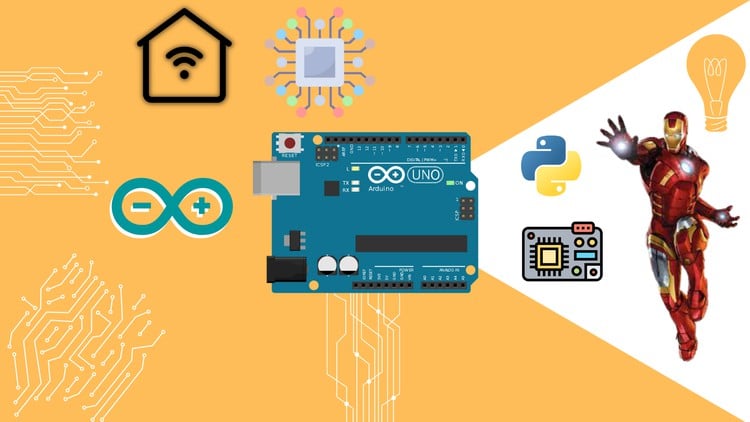
Learn To Create Advance AI Assistant (JARVIS 2.0) Using Python Programming Language & Home Automation With Arduino UNO
⏱️ Length: 7.7 total hours
⭐ 4.19/5 rating
👥 22,897 students
🔄 March 2023 update
Add-On Information:
Note➛ Make sure your 𝐔𝐝𝐞𝐦𝐲 cart has only this course you're going to enroll it now, Remove all other courses from the 𝐔𝐝𝐞𝐦𝐲 cart before Enrolling!
Course Overview
- This “Mega Course” offers an immersive journey into building a sophisticated AI assistant akin to J.A.R.V.I.S, leveraging the power of Python. It transcends theoretical knowledge by guiding learners through a comprehensive project-based curriculum, culminating in a functional AI capable of understanding commands and interacting with the real world. More than just a voice assistant, this course bridges the gap between software intelligence and physical actions, specifically in the realm of home automation. Participants will discover the intricate synergy required to integrate advanced AI functionalities with microcontroller-based systems like Arduino, providing a holistic understanding of intelligent environments and how to engineer them from the ground up.
Requirements / Prerequisites
- To maximize your learning experience, a foundational understanding of Python programming concepts is highly recommended. This includes familiarity with data types, control flow (loops, conditionals), functions, and basic object-oriented programming principles. While not strictly mandatory, an eagerness to learn about hardware-software interaction and problem-solving will be highly beneficial. Additionally, access to a computer with a stable internet connection is essential. For the practical home automation component, an Arduino UNO board, a breadboard, jumper wires, and basic electronic components (e.g., LEDs, resistors, relays) will be necessary.
Skills Covered / Tools Used
- This course meticulously covers a spectrum of cutting-edge skills and practical tools essential for modern AI and IoT development. You will gain proficiency in advanced Python scripting for developing intelligent applications, moving beyond basic syntax to implementing complex logic and robust system architectures.
- Key AI capabilities explored include robust Speech-to-Text (STT) conversion for accurately understanding spoken commands and intuitive Text-to-Speech (TTS) synthesis for generating natural-sounding responses, making your AI assistant truly interactive.
- Learners will delve into fundamental Natural Language Understanding (NLU) techniques, enabling the AI to interpret user intent, extract key information from queries, and respond appropriately to diverse commands, ranging from general knowledge questions (integrating with APIs like Wikipedia) to controlling smart devices.
- The curriculum also emphasizes strategic API integration, teaching how to connect your AI with external web services for fetching real-time data (e.g., weather, news), performing automated web searches, and executing various online tasks to enhance your assistant’s capabilities.
- On the hardware front, you’ll acquire practical skills in Arduino microcontroller programming, learning to interface various sensors and actuators. This includes understanding digital and analog input/output, controlling relays for switching home appliances, and establishing reliable serial communication between your Python AI and the Arduino board.
- Furthermore, the course introduces concepts of event-driven programming for responsive AI interactions and basic system automation design principles, ensuring your J.A.R.V.I.S 2.0 can orchestrate complex routines and manage multiple tasks seamlessly.
Benefits / Outcomes
- Upon successful completion, you will possess a tangible, high-impact project for your portfolio: a fully functional J.A.R.V.I.S 2.0 AI assistant integrated with practical home automation capabilities. This real-world application will serve as compelling evidence of your practical AI development and IoT integration expertise to potential employers or for personal projects.
- You will develop strong problem-solving and debugging skills as you navigate the complexities of combining sophisticated software intelligence with physical hardware. This includes troubleshooting communication issues, optimizing performance, and ensuring seamless operation across different components.
- The course empowers you to conceptualize, design, and implement intelligent systems from scratch, giving you a significant edge in the rapidly expanding fields of Artificial Intelligence, Smart Home Technology, and the Internet of Things. You will gain a holistic understanding of how these technologies converge, opening doors to advanced career opportunities and fostering personal innovation in creating your own smart environments.
PROS
- Highly Practical & Project-Oriented: Focuses on building a complete, real-world system rather than just theoretical concepts, providing hands-on experience.
- Comprehensive Skill Set: Bridges software development (Python, AI) with hardware interaction (Arduino, IoT), offering a unique blend of expertise.
- Strong Community & Social Proof: High student rating and large enrollment indicate a well-received and valuable course experience.
- Up-to-Date Content: March 2023 update ensures relevance with current technologies and best practices in AI and IoT.
- Tangible Outcome: Leaves you with a fully functional, impressive AI project for your portfolio, ready to showcase.
CONS
- Potential for additional costs associated with purchasing necessary hardware components for the home automation modules.
Learning Tracks: English,IT & Software,Other IT & Software
Found It Free? Share It Fast!