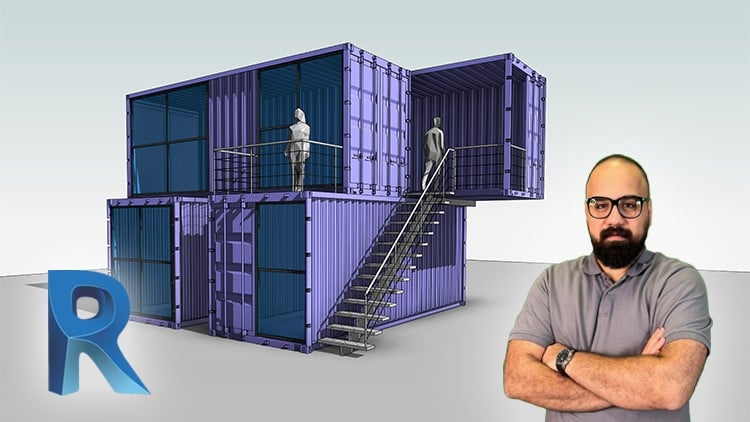
Create Advanced Revit parametric Families for containers & industrial design with quizzes & practical file
⏱️ Length: 2.3 total hours
⭐ 4.85/5 rating
👥 6,892 students
🔄 September 2025 update
Add-On Information:
Note➛ Make sure your 𝐔𝐝𝐞𝐦𝐲 cart has only this course you're going to enroll it now, Remove all other courses from the 𝐔𝐝𝐞𝐦𝐲 cart before Enrolling!
- Course Overview
- This specialized course offers an intensive exploration into the advanced functionalities of the Revit Family Editor, transforming you into a proficient creator of sophisticated custom, modular, and nested components.
- Designed for architectural, engineering, and industrial design professionals, it meticulously unravels the complexities of crafting intelligent parametric families that drive efficiency and flexibility in your BIM workflows.
- You will learn to architect families with a strategic mindset, ensuring they are robust, adaptable, and perform optimally across various project scales, moving beyond basic component usage.
- Emphasis is placed on developing highly versatile components crucial for industrial applications, such as intricate machinery, bespoke fittings, and dynamic container solutions.
- Discover the transformative power of a well-constructed nested family, allowing complex assemblies from simpler, interchangeable parts, enhancing project organization and modification capabilities.
- The curriculum provides a comprehensive framework for executing advanced parametric logic, empowering you to build components that not only look right but also behave intelligently within Revit models.
- Explore industry best practices for family content creation, ensuring your custom components adhere to high standards of quality, data integrity, and cross-project reusability.
- Requirements / Prerequisites
- Foundational Revit Familiarity: A working knowledge of the Revit user interface, including basic navigation, element selection, and elementary modeling commands, is essential for optimal engagement.
- Active Autodesk Revit Software: Access to an installed and operational version of Autodesk Revit (preferably 2020 or a newer release) is required to actively participate in the hands-on exercises and practical file applications.
- Conceptual Understanding of 3D Geometry: Prior exposure to fundamental 3D modeling concepts, such as planes, solids, voids, and coordinate systems, will aid in grasping the principles of parametric construction.
- Commitment to Precision: A willingness to engage with detailed procedures and precise constraint management is crucial, as the course focuses on accuracy in family definition and behavior.
- Basic Computer Literacy: Proficiency with general computer operations, file management, and internet navigation to access course materials and quizzes.
- No Advanced Family Editor Experience Needed: While beneficial, prior in-depth experience with the Revit Family Editor is not a prerequisite; the course builds from a capable foundation towards expert-level skills.
- Skills Covered / Tools Used
- Mastering Reference Planes and Lines: Advanced techniques for establishing robust, logical frameworks using named reference planes and lines, the parametric skeletal structure.
- Strategic Parameter Deployment: In-depth application of instance, type, shared, family, and global parameters to control geometry, materials, visibility, and data dynamically.
- Complex Formula Construction: Crafting sophisticated formulas involving arithmetic operations, conditional statements (IF/THEN), and logical functions for intelligent component behaviors.
- Implementing Lookup Tables and Type Catalogs: Techniques for managing vast family types and variations through external CSV files, enabling efficient parameter population for extensive libraries.
- Advanced Nesting and Shared Nesting: Comprehensive methodologies for creating hierarchical family structures, including the critical distinction and application of shared nested components for enhanced project data and scheduling.
- Controlling Visibility and Graphics: Utilizing visibility parameters, graphic overrides, and different levels of detail (Coarse, Medium, Fine) to optimize family representation and project performance.
- Precise Void Geometry Creation: Employing advanced void forms (extrudes, blends, revolves, sweeps) to sculpt complex cutouts, openings, and intricate negative spaces within solid geometry.
- Material Parameterization and Management: Developing families with dynamic material assignments controllable at the project level, enhancing rendering quality and accurate material take-offs.
- Dimensioning and Constraining for Stability: Applying robust dimensioning and constraint techniques to ensure family geometry remains stable and predictable under parametric adjustments.
- Family Category and Subcategory Customization: Understanding implications of correct family categorization and subcategory assignment for proper documentation, filtering, and graphical representation.
- Performance Optimization Techniques: Strategies for creating lightweight, efficient families by managing detail, purging unused elements, and avoiding over-constraining to maintain project speed.
- Benefits / Outcomes
- Unparalleled Design Agility: Rapidly adapt to design changes, experiment with variations, and generate bespoke solutions for demanding industrial or architectural challenges.
- Significant Workflow Acceleration: Drastically reduce manual modeling time by leveraging intelligent, reusable components, allowing focus on design innovation over repetitive tasks.
- Become a BIM Content Specialist: Acquire a highly sought-after expertise in creating custom, high-quality Revit content, positioning you as an invaluable asset.
- Enhanced Project Data & Accuracy: Develop families that carry precise, actionable information, leading to more accurate schedules, material take-offs, and improved data analytics.
- Superior Documentation & Visualization: Produce clearer, more consistent construction documents and achieve realistic visualizations through meticulously crafted and parametrically controlled components.
- Expanded Career Opportunities: Open doors to specialized roles in BIM content development, parametric design, manufacturing integration, and advanced Revit project coordination.
- Confidence in Complex Modeling: Gain technical proficiency to tackle intricate industrial machinery, complex container designs, and other challenging geometries with precision and control.
- Future-Proof Skill Set: Invest in a core Revit skill that remains relevant and highly valued across all software versions and diverse industry sectors, ensuring long-term professional growth.
- Build a Professional Content Library: Start building your own invaluable library of custom-engineered, intelligent Revit families ready for deployment in future projects.
- PROS
- Highly Niche and In-Depth: Provides specialized, focused training on a critical and often underdeveloped Revit skill area.
- Direct Industry Relevance: Specifically tailored examples and exercises around containers and industrial design ensure practical, real-world applicability of learned skills.
- Interactive Learning Support: Includes quizzes to test understanding and practical files for hands-on application, fostering active learning.
- Proven Quality & Popularity: Boasts an impressive 4.85/5 rating from a substantial base of 6,892 students, indicating high satisfaction and effectiveness.
- Ensured Content Freshness: The September 2025 update guarantees the course material is current, reflecting the latest Revit features and industry best practices.
- Time-Efficient Skill Acquisition: A concise 2.3 total hours allows for rapid learning of advanced concepts without a lengthy time commitment.
- Instructor-Led Expertise: Implies instruction from an experienced professional, offering insights beyond basic software functions.
- Immediate Practical Application: Learn skills that can be directly applied to ongoing or future design and modeling projects, providing instant value.
- CONS
- Requires Consistent Self-Practice: While comprehensive, true mastery of advanced parametric family creation demands dedicated practice and experimentation beyond the course hours.
Learning Tracks: English,Design,Architectural Design
Found It Free? Share It Fast!