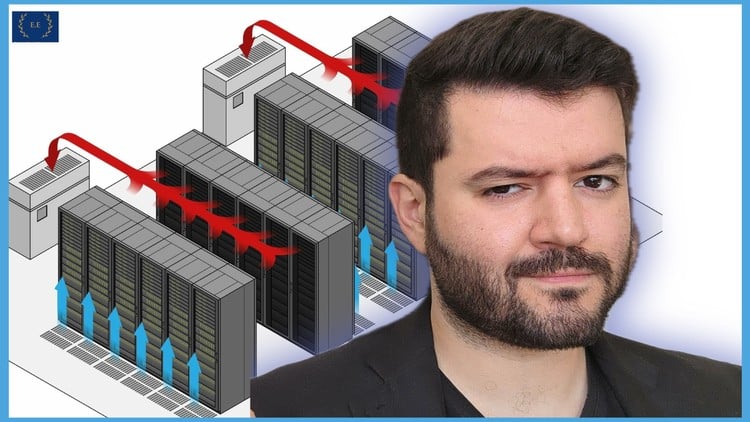
Data Center HVAC Design for Beginners/Data Center HVAC Engineering/Data Center Infrastructure/Data Center HVAC systems
⏱️ Length: 3.4 total hours
⭐ 4.25/5 rating
👥 5,675 students
🔄 March 2025 update
Add-On Information:
Note➛ Make sure your 𝐔𝐝𝐞𝐦𝐲 cart has only this course you're going to enroll it now, Remove all other courses from the 𝐔𝐝𝐞𝐦𝐲 cart before Enrolling!
- Course Overview
- Embark on a comprehensive journey into the critical domain of Data Center HVAC Design and Infrastructure, a dual-certification program designed to equip you with advanced, practical knowledge.
- This meticulously crafted course transcends theoretical introductions, offering an accelerated pathway to mastering complex HVAC principles that typically require years of hands-on experience.
- Gain an unparalleled advantage by bypassing the arduous process of sifting through fragmented and often contradictory information, allowing you to confidently design and manage data center environmental controls.
- The curriculum is structured to demystify one of the most technically challenging aspects of data center operations, providing clarity and actionable insights for both aspiring and established professionals.
- Through a blend of foundational concepts and sophisticated design methodologies, you will develop the expertise to ensure optimal performance, reliability, and energy efficiency in any data center environment.
- This intensive program is ideal for anyone seeking to gain a deep understanding of the intricate relationship between IT load and environmental management within a data center.
- The course culminates in a dual certification, signifying your proficiency in both the design and overarching infrastructure aspects of data center HVAC.
- Target Audience & Prerequisites
- This course is specifically tailored for IT professionals, facility managers, building engineers, HVAC technicians, project managers, and anyone involved in the planning, design, construction, or operation of data centers.
- No prior specialized HVAC knowledge is strictly required, though a basic understanding of building systems or IT infrastructure will be beneficial.
- Familiarity with fundamental physics principles (heat transfer, thermodynamics) is advantageous but not mandatory, as the course will revisit core concepts as they apply to data centers.
- An interest in problem-solving and a willingness to engage with technical details are the most crucial prerequisites for success.
- Key Learning Objectives & Practical Applications
- Develop a robust understanding of the thermodynamic principles governing heat generation and dissipation within a confined data center space.
- Learn to analyze and interpret the impact of various IT equipment densities and power consumption patterns on the overall cooling requirements.
- Explore a spectrum of cooling technologies, from traditional CRAC/CRAH units to advanced liquid cooling solutions, and understand their deployment considerations.
- Master the art of airflow management, including hot aisle/cold aisle containment strategies and the simulation of air movement to prevent hot spots.
- Gain proficiency in selecting and sizing appropriate HVAC components, such as chillers, condensers, pumps, and distribution systems, based on specific project needs.
- Understand the critical role of humidity control in preventing electrostatic discharge (ESD) and equipment condensation, and learn techniques for maintaining optimal humidity levels.
- Investigate the integration of redundant HVAC systems for high availability and fault tolerance, ensuring continuous operation during maintenance or equipment failure.
- Learn to evaluate the energy efficiency of different HVAC designs and identify opportunities for optimization through variable speed drives, economizers, and free cooling techniques.
- Explore the importance of power distribution and control systems as they interface with HVAC infrastructure.
- Develop a foundational understanding of building management systems (BMS) and how they are used to monitor and control data center environmental conditions.
- Understand the lifecycle considerations of HVAC systems in a data center, including installation, commissioning, maintenance, and decommissioning.
- Learn to conduct site assessments and identify potential environmental challenges specific to data center locations.
- Skills Covered / Tools Used
- HVAC System Design & Analysis: Ability to conceptualize, design, and analyze HVAC solutions tailored for data center environments.
- Cooling Load Calculation Expertise: Proficiency in performing accurate thermal load calculations for diverse IT loads.
- Airflow Management Techniques: Competence in implementing effective strategies to optimize air circulation and temperature uniformity.
- Component Selection & Sizing: Skill in choosing and dimensioning appropriate HVAC equipment for optimal performance.
- Energy Efficiency Optimization: Capacity to design and implement energy-saving measures within HVAC systems.
- Redundancy & Reliability Planning: Understanding of designing for high availability and fault tolerance.
- Infrastructure Integration: Knowledge of how HVAC integrates with power, fire suppression, and building management systems.
- Problem-Solving & Troubleshooting: Ability to identify and resolve common data center environmental issues.
- Practical Case Studies & Scenarios: Application of learned concepts to real-world data center design challenges.
- Benefits / Outcomes
- Achieve a professional designation that significantly enhances your resume and career prospects in the booming data center industry.
- Gain the confidence to make informed decisions regarding data center environmental infrastructure, leading to improved operational efficiency and reduced risk.
- Become a valuable asset to organizations by contributing to the design and maintenance of reliable, high-performing data centers.
- Develop the ability to communicate effectively with vendors, engineers, and stakeholders on complex HVAC-related matters.
- Empower yourself to identify and implement cost-saving measures through optimized HVAC design and operation.
- Position yourself as a subject matter expert in a critical and often underserved area of data center management.
- Receive practical, actionable knowledge that can be applied immediately to ongoing or future data center projects.
- Understand the evolving landscape of data center cooling technologies and their implications for future designs.
- PROS
- Accelerated Expertise: Condenses years of learning into a manageable timeframe, providing a significant career advantage.
- Practical Application Focus: Emphasizes real-world scenarios and step-by-step guidance for immediate implementation.
- Dual Certification Value: Offers recognition in two key areas, broadening skill applicability and marketability.
- Addresses a Critical Skill Gap: Equips professionals with knowledge in a complex and essential data center discipline.
- Comprehensive Curriculum: Covers a wide range of topics from fundamental principles to advanced design strategies.
- Expert-Led Instruction: Likely benefits from insights of experienced professionals in the field.
- CONS
- Intensity of Learning: Requires focused dedication to absorb a significant amount of technical information within a short period.
Learning Tracks: English,Teaching & Academics,Engineering
Found It Free? Share It Fast!